
An Amish shed in Maryland runs from about $4,700 for a small standard shed to $15,000 or more for a large workshop or garage-style structure, and delivery typically takes two to four weeks, longer during the spring rush. Whether you need a permit depends on the size of the shed and the county you live in, so before you fall in love with a floor plan, it helps to know the three things that actually decide the project: what’s allowed where you live, where the shed can sit on your lot, and what it costs delivered and set.
This guide walks a Maryland homeowner through all three, with specific attention to Anne Arundel County, where our Millersville store sits. Pine Creek Structures has been building Amish sheds for 40 years, and the questions below are the ones we answer on the phone every day.
What makes a shed “Amish-built,” and why does it cost more?
An Amish-built shed is framed and finished by Amish craftsmen using careful stick-built construction rather than mass-production shortcuts. The phrase is not marketing decoration. It points to a specific building tradition and a specific level of workmanship.
Here is what you are actually paying for:
-
Solid framing. Walls are stud-framed with double top plates and double-studded, interlocking corners, so the building stays square and carries snow load and stored weight without racking.
-
Real construction, not a kit. The shed arrives assembled. You are not building it yourself in a weekend, and there are no missing panels or stripped screws to deal with.
-
Better materials. LP SmartSide siding, architectural shingles, and pressure-treated floor systems are standard rather than upgrades on many models. LP SmartSide has the outer look of the T1-11 you may know, but the similarities stop there: it is engineered to resist rot, warping, and impact in a way T1-11 does not.
-
A warranty that stands behind it. Pine Creek Structures backs its buildings with a 6-Year Top-To-Bottom warranty, and the LP SmartSide carries a 5-year/50-year manufacturer warranty. Vinyl siding is warrantied for life (limited), Legacy Metals roofing carries a 40-year paint warranty, and PerformMAX floors are warrantied for 25 years.
A big-box vinyl or resin shed is cheaper up front. It also flexes in wind, yellows in sun, and cannot be repaired panel by panel. The Amish approach costs more because the building is built to last and warrantied to prove it. That is the quality-over-price tradeoff, and it is the reason people drive to Millersville rather than order a flat-pack online.
How much does an Amish shed cost in Maryland?
Price tracks size, siding, roof style, and how much you customize. These are typical delivered ranges, not quotes:
-
Economy line (Madison Peak, 6×8 to 8×10): roughly $2,600 to $3,300 as a product-line price. These are the entry point, and they carry a 1-year warranty rather than the 6-Year Top-To-Bottom warranty on the standard line, so weigh that before you buy on price alone. Availability varies by location, so call the Millersville store to confirm what is in stock.
-
Small standard sheds (8×10 to 8×12): roughly $4,700 to $7,400. An 8×10 Clubhouse runs around $4,744; an 8×12 Cape Cod runs about $5,813 to $6,103. Good for mowers, tools, and seasonal storage.
-
Mid-size sheds (10×12 to 10×14): roughly $5,900 to $9,500 depending on style. A 10×12 Front Peak runs around $6,342 to $6,686; a 10×14 Victorian Deluxe runs $8,501 to $9,517. Room for a riding mower, a workbench, and bikes.
-
Large sheds and workshops (12×20 and up): roughly $8,100 to $15,100. A 12×20 Dutch Workshop starts around $8,090 and runs to about $10,891 configured; a Lean-To Studio with a porch reaches about $15,108 configured. Workshop, home office, or storage with a loft.
Prices above are real in-stock Millersville figures at the time of writing, not quotes, except the economy line, which is a product-line price. Garage-style buildings are built to order and are not always in stock at Millersville, so call the store at 410-729-8747 for a current garage price.
What moves the number up:
-
Siding choice (LP SmartSide is the most affordable; vinyl, board-and-batten, and cedar step up from there).
-
Roof upgrades (metal roofing, higher pitch, dormers).
-
Windows, extra doors, ramps, workbenches, and shelving.
-
Insulation and finished interior if you plan to heat the space.
-
Site prep and delivery distance.
Two costs people forget to budget for are the foundation or pad and delivery access. Most Maryland homeowners set an Amish shed on a level gravel pad, which is the cheapest sound option, or on a concrete slab if they want a garage or a heated workshop. Pine Creek specifies a treated-timber perimeter (4×4, 4×6, or 6×6) filled with crushed 2B stone, or stone spread on a level base without timbers as the cheaper option that needs more upkeep. A slab costs more than either.
One pad detail is not optional: the warranty requires the shed to sit on a properly prepared pad of at least 4 inches of 2B crushed stone, extending about a foot past the building on all sides. Set the shed on bare dirt, mulch, or grass and you can void the warranty, because the building needs drainage and a stable base to stay square. Get the pad right before delivery day and it protects everything else you spend.
Financing and rent-to-own are available on many models if you would rather spread the cost. Rent-to-own runs roughly $50 per month for every $1,000 of retail price, up to $9,000 over 36 months. It does not cover built-on-site structures, animal shelters, two-story buildings, buildings without floors, or cabins, and it is not available at all locations, so larger workshops and garages are typically purchase or finance only.
Do I need a permit for a shed in Anne Arundel County?
Here is the honest answer: Anne Arundel County does not publish a square-footage threshold that tells you when a shed needs a building permit. Its own accessory-structure page says a shed or detached garage “may require a building permit” and directs you to call. The same is true of permit processing times, how the county treats a shed on skids versus a poured foundation, and clearance from a septic field or well. None of it is published. That is not an oversight on the county’s part, since these depend on your specific parcel, but it does mean a phone call is the only reliable route. This section shows you exactly how to get your answer in two calls.
Call the county to confirm your specific project:
-
Permits (Inspections and Permits): 410-222-7730. Ask whether your size and site need a building permit, and what the fee would be. The building permit fee is based on the estimated value of the work, not a flat shed fee, so it varies with the building.
-
Zoning Administration: 410-222-7437. Ask for your setbacks and any lot-coverage or height limits for your parcel.
A few things to understand about how the county treats sheds:
-
Permit exemption is not the same as rule exemption. Even a shed too small to need a building permit still has to meet zoning setbacks, height limits, and lot-coverage limits. “No permit” never means “put it anywhere.”
-
Portable versus permanent can matter. A shed set on a gravel pad or skids is often treated differently from one on a poured foundation, but the county does not publish how it draws that line, so ask when you call.
-
Critical Area rules are stricter. If your property is within the Chesapeake Bay Critical Area, impervious-surface limits apply (roughly 15% to 31% of the site depending on designation), and one detail catches waterfront owners off guard: the county’s lot-coverage definition counts anything “covered with gravel, stone, shell, impermeable decking,” so your gravel pad counts against the limit, not just the shed’s footprint. Reach the Critical Area Division at 410-222-7960.
If a permit is required, you file with the Anne Arundel County Office of Planning and Zoning. As of December 1, 2025, the county requires all new permit applications to be submitted online through the Land Use Navigator (LUN) system, and the Permit Center takes questions at permitcenterhelp@aacounty.org. Because the fee is tied to the estimated value of the work rather than a fixed shed rate, ask for the figure when you call so you can budget it.
At Pine Creek Structures in Millersville, we can tell you which of our standard sizes typically fall under the exemption and which usually trigger a permit, but the county makes the final call on your specific lot. Confirm your number with the county before you order.
Where can I put a shed on my property? Setbacks explained
Setbacks are the rule that surprises people most, and in Anne Arundel County they vary by zoning district and by development type: regular subdivision, cluster, or PUD. Your HOA or a recorded covenant can be stricter than the county, and the county will not tell you about either. You can find your own zoning district on the county’s Land Use and Zoning Map Viewer, and we cover the specifics in our full guide to Anne Arundel County shed setback requirements. Before you visit Millersville, measure the distance from your house to each property line and note where utilities, septic, and easements run. That one step lets us match you to a size that fits the lot legally, not just one that looks good in the catalog.
Utilities, septic, and easements: the things buried in the yard
Before anything gets set, call Miss Utility of Maryland at 811 or file online to have underground lines marked. Maryland requires at least 3 business days’ notice before you dig, and the ticket expires after 12 business days, so file it about a week ahead of your delivery date, not the morning of. It is free, it is required before digging for a pad or anchors, and it prevents an expensive mistake.
Other buried concerns specific to Maryland lots:
-
Septic and drain fields. Many Anne Arundel properties are on septic. You generally cannot set a shed on top of a drain field or reserve area. State code (COMAR) requires a 25-foot downslope protection zone kept free of buildings and driveways for sand mound and at-grade systems, but there is no published general building-to-drainfield setback. That number is set by the county health department for your specific system, so confirm it with them.
-
Easements. Utility and drainage easements often run along property lines, exactly where people want to tuck a shed. You cannot build over most easements.
-
Wells. If you have a well, there is a required clearance. State code sets well-to-septic separation (100 feet in unconfined aquifers, 50 feet in confined), which is why the two are sited apart, but the well-to-shed distance is a county health department call. Confirm it with them.
How are Amish sheds delivered, and what do I need to prepare?
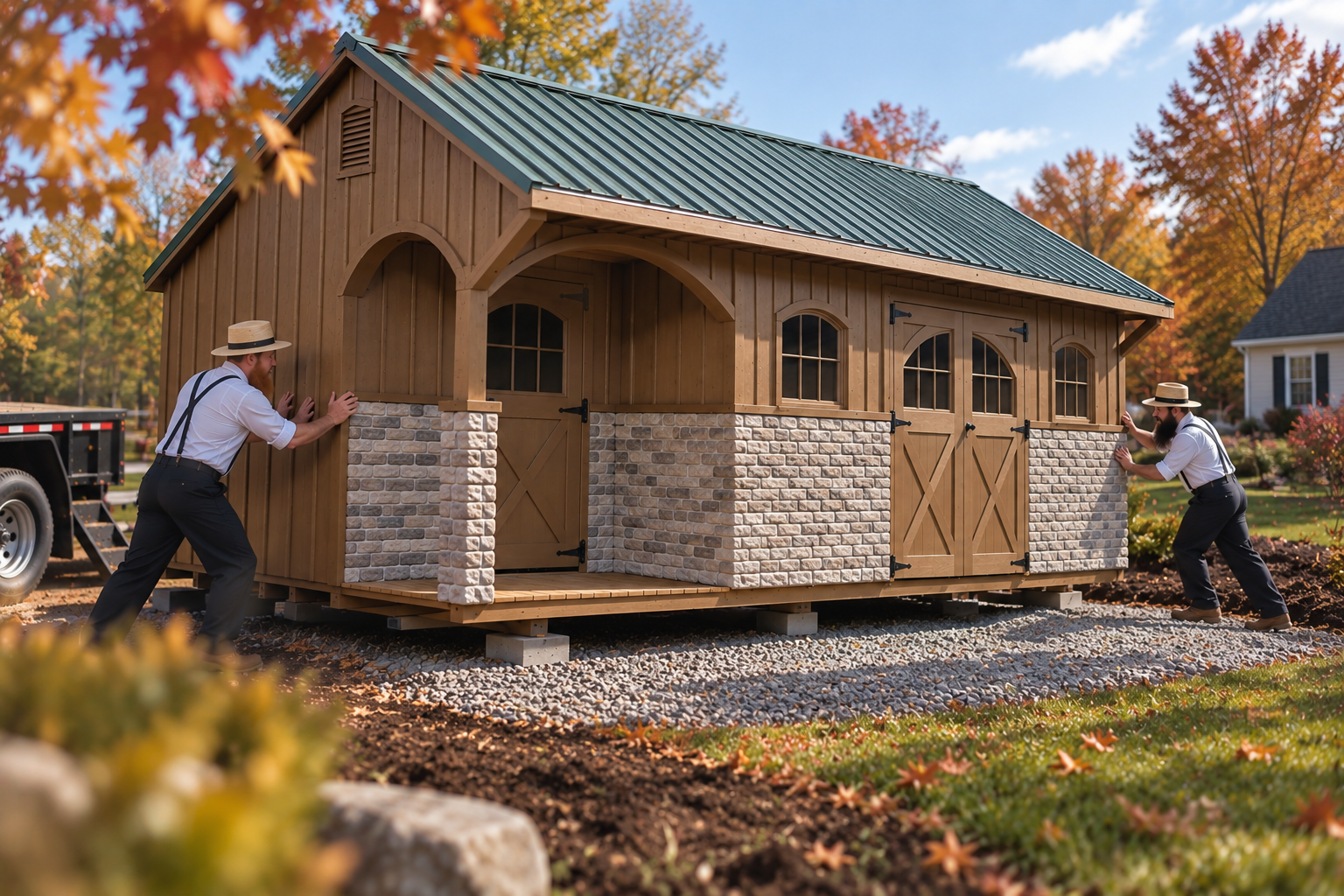
Most Amish sheds are delivered fully assembled on a truck and trailer, which is backed or pulled into position and sets the building down on your pad. If your access is tight, your yard is soft, or a trailer simply cannot get there, Pine Creek offers delivery by Shed Mule for an additional fee, a compact motorized carrier that handles slopes up to 30 degrees, makes 90-degree turns, and needs about 20 inches less overhead clearance than standard equipment. It reaches places a truck cannot. Larger buildings and garages may be delivered in sections and assembled on site.
For a smooth delivery, you need:
-
A clear path. The delivery equipment needs an opening wide enough for the shed plus clearance. A standard gate is often too narrow. Measure your access point and fence openings before delivery day.
-
A firm, level surface. Soft or sloped ground can stop a delivery. Have your gravel pad or slab ready before the scheduled date.
-
Overhead clearance. Low branches, wires, and eaves can block the path.
If the Shed Mule cannot reach the spot, a crane delivery is sometimes possible at additional cost. Our team at Pine Creek Structures reviews access with you before delivery so there are no surprises when the truck arrives in Millersville-area neighborhoods.
How long does it take to get an Amish shed in Maryland?
Pine Creek typically delivers within two to four weeks of your order, depending on the season and the options you choose. Spring and early summer are the busiest ordering months, so lead times stretch then. If you want a shed for spring, ordering in late winter is the smart move. Permit approval, if your size requires it, runs on the county’s timeline and is separate from the build time, so start that early.
Buying an Amish shed near me: what to bring to the Millersville store
Searching “amish sheds near me” from an Annapolis, Severna Park, or Glen Burnie address will point you to our Millersville location. To make the visit productive, bring:
-
Your lot dimensions and the distance from the house to each property line.
-
Your zoning district if you have it, or your address so we can help look it up.
-
Photos of the delivery path and any gates.
-
A rough budget and whether you want to finance or pay outright.
-
Any HOA architectural guidelines that apply.
You can also design your building before you come in. The online 3D builder on mdsheds.com lets you set size, siding, roof, doors, and windows and see the price as you go, which makes the in-person conversation faster.
The bottom line for Maryland homeowners
An Amish shed is a long-term structure, so the money you spend confirming permits and setbacks up front protects the larger money you spend on the building. Get your Anne Arundel County permit answer and setback numbers straight in a couple of phone calls, call 811 before you dig, ready your pad, and order early enough to beat the spring rush.
When you are ready, browse shed models and start a design on mdsheds.com, or call the Millersville store at 410-729-8747 to talk through your lot with someone who has been placing Amish sheds on Maryland properties for 40 years. Pine Creek Structures is at 8236C Veterans Highway, Millersville, MD 21108.
Please note that due to a rapidly changing market, all prices are subject to change without notice. We make every effort to update web pricing and brochure pricing as quickly as possible. We always encourage you to confirm pricing with the local manager.
Frequently Asked Questions
Do I need a permit for a shed in Anne Arundel County, Maryland?
It depends on the size of the shed and your specific lot, and Anne Arundel County does not publish a square-footage threshold that tells you when a permit is required. The county's accessory-structure page says a shed or detached garage "may require a building permit" and directs you to call. Get your answer in two calls: Inspections and Permits at 410-222-7730 for the permit question, and Zoning Administration at 410-222-7437 for your setbacks. The building permit fee is based on the estimated value of the work, not a flat shed fee.
How much does an Amish shed cost in Maryland?
Real in-stock prices at the Millersville store currently run from about $4,744 for a small standard shed (an 8×10 Clubhouse) to $15,108 for a large configured workshop (a 12×20 Lean-To Studio with a porch). A 10×14 Victorian Deluxe runs $8,501 to $9,517. The Madison economy line starts around $2,600 as a product-line price, though availability varies by store. Price tracks size, siding, roof style, and options, and you should budget separately for a gravel pad and delivery access.
How far from my property line does a shed have to be in Anne Arundel County?
Setbacks vary by zoning district and also by development type: regular subdivision, cluster, or PUD. Because of that, there is no single distance that applies to every lot, so confirm yours with Zoning Administration at 410-222-7437. An HOA or a recorded covenant can be stricter than the county, and the county will not tell you about either. See our full guide to Anne Arundel County shed setback requirements for the specifics.
How long does it take to get an Amish shed delivered in Maryland?
Pine Creek typically delivers within two to four weeks of your order, depending on the season and the options you choose. Spring and early summer are the busiest ordering months, so order in late winter if you want a shed ready for spring. Permit approval, if your size requires one, runs on the county's timeline and is separate from the build time, so start that process early.
How is an Amish shed delivered, and what do I need to prepare?
Most sheds are delivered fully assembled on a truck and trailer, which is backed into position and sets the building on your pad. Where access is tight or the ground is soft, Pine Creek offers delivery by Shed Mule for an additional fee, a compact carrier that reaches places a truck cannot. You need a clear path wide enough for the shed plus clearance (a standard gate is often too narrow), a firm and level surface such as a gravel pad or slab, and overhead clearance from branches and wires. Larger buildings and garages may be delivered in sections and assembled on site, and a crane is sometimes possible at extra cost.
What does the warranty require for the shed's foundation?
Pine Creek Structures requires the shed to sit on a properly prepared pad of at least 4 inches of 2B crushed stone, extending about a foot past the building on all sides. Setting the shed on bare dirt, mulch, or grass can void the warranty, because the building needs drainage and a stable base to stay square. Get the pad right before delivery day and it protects everything else you spend.
Are Amish sheds worth it?
For homeowners who plan to keep the building, generally yes. You pay more up front than a big-box kit, but you get stick-built framing with double top plates and double-studded corners, engineered siding, and a real warranty: a 6-Year Top-To-Bottom warranty from Pine Creek plus manufacturer coverage running to 50 years on LP SmartSide and 40 years on Legacy Metals roof paint. A big-box shed is cheaper on day one and cannot be repaired panel by panel. If you only need to cover a mower for a season or two, a kit may be enough.