

An Amish-built garage in Maryland costs more than a warehouse kit because it is a permanent, framed building put up by full-time crews, not a flat-pack panel kit you assemble in a weekend. What you are actually paying for is documented in the warranty: a 6-Year Top-To-Bottom warranty on heavy-duty buildings, LP SmartSide siding under a 5/50-year warranty (five years of full labor and material replacement, prorated material coverage to year 50) plus separate coverage against termite and fungal decay, and roofing options carrying a 40-year paint guarantee and a 160-mph wind rating. By Pine Creek’s own comparison, competitors offer “2-4 year warranties or no warranties at all.” This guide breaks down what that premium buys, what these garages cost, and why Maryland treats a detached garage differently than a shed.
Pine Creek Structures has been building Amish outdoor structures for 40 years, and the Millersville, Maryland store on Veterans Highway sells and delivers these garages across Anne Arundel, Baltimore, Howard, Montgomery and the surrounding counties. Here is the honest version of what you are actually buying.
Are Amish-built garages worth the extra money?
For most Maryland homeowners keeping a vehicle, a workshop, or years of stored equipment out of the weather, yes. The premium over a big-box kit is real, but so is the difference in what shows up in your backyard. A warehouse kit is engineered to a price point. An Amish-built garage is engineered to last.
The short version of the value argument:
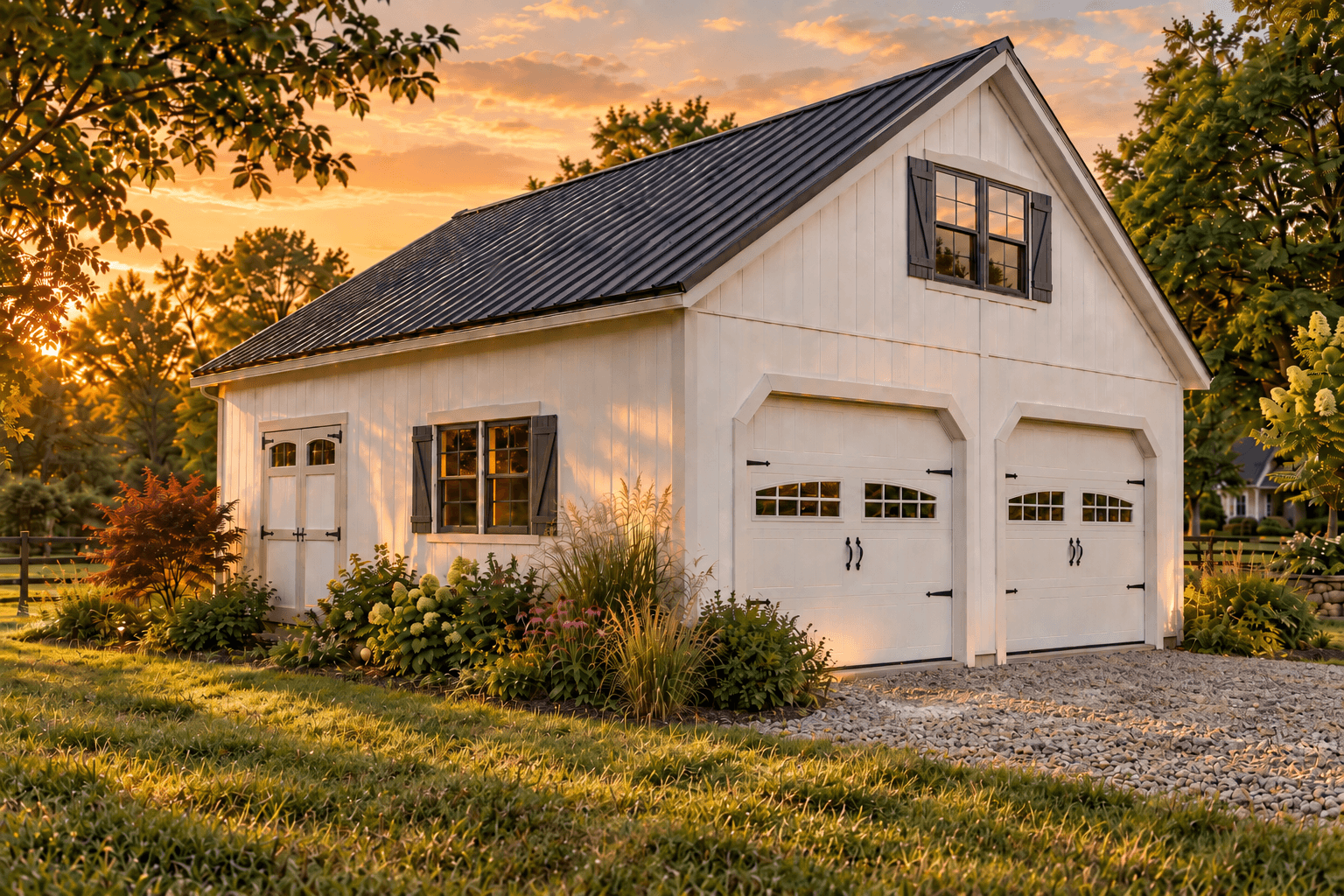
It is a building, not a kit. Amish-built garages are constructed as permanent structures, then either delivered complete or built on site depending on size and access.
Heavier construction. Framing uses kiln-dried lumber with double top plates and double-studded interlocking corners, fastened with nails rather than staples. Garage floors are built to a higher spec than sheds: 12-inch joist spacing instead of 16-inch, and 3/4-inch floor sheeting instead of 5/8-inch.
It is a permitted, permanent structure. A garage built to carry a vehicle gets permitted as a building, and stays on the property as one.
The warranty is contractual, not estimated. Pine Creek backs the heavy-duty line with a 6-Year Top-To-Bottom warranty (1 year on the economy Madison line) and layers component warranties on top: LP SmartSide at 5/50 years, vinyl siding lifetime limited, PerformMAX flooring 25 years against delamination.
If your only need is to cover a lawn mower for a few seasons, a kit may be the rational choice. If you are putting a vehicle, tools, or a workshop inside a building you expect to keep, the math tends to favor the built structure. The premium is justified when you plan to keep the building.
What are you actually paying for in an Amish-built garage?
The word “Amish” gets used loosely. What it should mean is a building put up by experienced full-time crews using materials chosen for durability rather than the lowest bid. Here is where the money goes.
The framing and structure
The bones of the building are the single biggest reason one garage outlasts another. Wall studs, headers over the garage door, roof rafters or trusses, and the way it is all fastened together determine whether the structure stays square through decades of Maryland freeze-thaw cycles and summer humidity.
Pine Creek frames with kiln-dried lumber, not green or wet stock, which resists warping and twisting as it cures. Walls are built with double top plates and double-studded interlocking corners, and the building is nailed rather than stapled. On garages specifically, the overhead door opening gets a 6-inch solid reinforcement at the impact point, because that is where a door frame takes the most abuse over its life.
The siding and exterior
Pine Creek builds with LP SmartSide, an engineered wood siding treated to resist rot, moisture, and insects. It carries a 5/50-year limited warranty (five years of full labor and material replacement, then prorated material coverage through year 50), and is separately warranted against structural damage from termites and fungal decay. It also holds paint well through Maryland’s humid summers and wet winters. LP SmartSide is Pine Creek’s most affordable siding, not a premium upgrade. Vinyl siding is also available and carries a lifetime limited, 50-year transferable warranty, and the Haley paint finish is backed for 12 years.
The roof
Roofing options carry real numbers. Legacy Metals metal roofing comes with a 40-year paint guarantee. Tamko Titan XT architectural shingles are rated for 160-mph wind and Class 3 impact. Both outlast the three-tab shingles common on the cheapest units. A better roof is the difference between a garage that stays dry and one that quietly rots from the top down.
The doors, windows, and finish work
Garage doors, entry doors, windows, and trim are where a build either feels finished or feels temporary. Overhead door quality, weather sealing, and the option for insulation all move the price and the long-term comfort of the space.
The labor and the build
You are paying for people who build these structures every day. That shows up in tight joints, doors that hang square, and a roofline that stays straight. It is the hardest part to put on a spec sheet and the first thing you notice in a cheap building.
Amish-built garage vs. warehouse kit: a side-by-side
The comparison most Maryland buyers are actually weighing is a delivered Amish-built garage against a kit from a big-box or warehouse retailer. Here is how they line up.
| Amish-built garage | Warehouse kit | |
|---|---|---|
| What arrives | A finished building, delivered complete or built on site | Flat-packed panels and hardware you assemble |
| Framing | Kiln-dried lumber, double top plates, double-studded interlocking corners, nailed | Engineered to a price point |
| Floor build | 12-inch joist spacing, 3/4-inch sheeting | 5/8-inch or thinner, varies |
| Siding | LP SmartSide (5/50-year) or vinyl (lifetime limited) | Thin panel or vinyl, varies |
| Roofing | Legacy Metals (40-year paint) or Tamko Titan XT (160-mph wind) | Three-tab or basic panel |
| Warranty | 6-Year Top-To-Bottom on the heavy-duty line | 2–4 years, or none |
| Labor | Full-time experienced crews | You, or a hired handyman |
| Up-front cost | Higher | Lower |
| Cost per year of use | Often lower across the life of the building | Higher if it needs early replacement |
Competitor warranty range per Pine Creek’s own published comparison.
The kit wins on the sticker. The built garage tends to win on cost per year, because you divide the price across a much longer service life. That is the real “worth it” calculation.
How much does an Amish-built garage cost in Maryland?
Price depends on size, one story or two, single or double doors, siding and roofing choices, insulation, and whether the crew delivers it complete or builds it on your site. Site-built garages and larger two-story buildings cost more because of the labor and the foundation work involved.
A few things that move the number:
Size and door count. A single-car footprint versus a two-car footprint is the biggest lever.
One story vs. two. A second story or loft space adds usable square footage and cost.
Delivery vs. on-site build. Larger buildings that can’t be delivered in one piece are constructed on your lot.
Foundation. A gravel pad, a concrete slab, or a full foundation each carry different cost and permit implications.
Upgrades. Insulation, extra windows, upgraded doors, and electrical rough-in all add up.
The most reliable way to get a real number for your build is the 3D builder on mdsheds.com or a call to the Millersville store, because the price is specific to what you configure.
How long does an Amish-built garage last?
Rather than a lifespan estimate, judge the building by what Pine Creek will put in writing. The 6-Year Top-To-Bottom warranty on the heavy-duty line, LP SmartSide at 5/50 years, Legacy Metals roofing at 40 years on paint, PerformMAX flooring at 25 years against delamination, and Tamko Titan XT shingles rated to 160-mph wind are all terms you can hold them to. The framing and engineered siding are the reason these structures age slowly, but the warranty stack, not a guessed number of years, is the honest measure of how long the building is built to last.
Maintenance is light: keep the roof intact, keep the siding painted, keep water draining away from the base, and the building will outlast most of what else is in your yard.
Why isn’t a garage treated like a shed under Maryland permit rules?
This is the part that surprises people. In most Maryland jurisdictions, a small storage shed can go up under a size threshold with little or no permitting, but a detached garage usually crosses into full building-permit territory. The reasons are consistent even where the exact numbers differ by county.
Size and use push it over the threshold
Counties commonly exempt small accessory structures below a certain square footage. A garage is almost always larger than that exemption, and it is designed to be occupied and used, not just to store a mower. That combination typically triggers a building permit.
The building itself is also constructed to a heavier standard than a shed, which is part of why it reads as a permanent structure. Pine Creek garages use 12-inch floor joist spacing instead of the 16-inch typical on sheds, 3/4-inch floor sheeting instead of 5/8-inch, and a 6-inch solid reinforcement at the overhead door impact point. That is a floor and frame built to carry a vehicle, which is exactly the use that puts it under full building-permit rules.
Electrical means a separate permit
The moment you run power to the garage, for lights, outlets, or an opener, you are generally into a separate electrical permit and inspection on top of the building permit. Most homeowners want power in a garage, so plan for this. Please check with your local municipality for specifics on what is required to obtain a permit.
Setbacks may be different for a garage
How far the structure must sit from your property lines, the setback, can differ for a garage versus a small shed, and can also depend on whether it is attached or detached and how tall it is.
Foundation and inspections
A permitted garage often requires a defined foundation and a sequence of inspections (footing, framing, electrical, final) rather than the single sign-off a small shed might need.
One site-prep condition is not optional and it is on you, the customer: Pine Creek’s warranty is void without a pad of at least 4 inches of 2B crushed stone under the building. This is a warranty requirement, not a suggestion. Have the stone pad down and level before your delivery date, sized to the building’s footprint, or you risk both drainage problems and your coverage.
The rule of thumb: a shed is often something you can place, but a garage is usually something you have to permit. Budget the time and the fees for a real permit process before you set a delivery date.
Because these rules vary by county, and because Pine Creek delivers across Anne Arundel, Baltimore, Howard, Montgomery and beyond, the Millersville store can point you to what your specific jurisdiction requires. MD Sheds covers the county-by-county detached garage permit numbers in a separate guide, and every figure there is checked against the county’s own code.
What size garage do most Maryland homeowners buy?
The most common request is a two-car garage, wide enough for two vehicles or one vehicle plus a workshop and storage. Single-car garages suit tighter lots and lighter needs. Oversized and two-story builds appeal to homeowners who want a shop below and storage above, or room for a truck, trailer, or hobby space.
The right size is a function of your lot, your setbacks, and what you plan to keep inside. This is exactly where the 3D builder helps: you can configure the footprint, doors, and features and see the building before you commit.
Where to go next
If you have decided a real garage beats another kit, the next step is a configuration and a real price. Build yours on the 3D builder at mdsheds.com to see options and pricing, browse the garage category page to compare styles, or call the Pine Creek Structures store in Millersville, Maryland at 410-729-8747 to talk through sizing, delivery, and your county’s permit process.
Related reading
Frequently Asked Questions
Is it worth paying more for a custom Amish structure versus buying a kit from a warehouse retailer?
It is worth it when you plan to keep the building. A warehouse kit is engineered to a price point and arrives as flat-packed panels you assemble yourself. A Pine Creek garage arrives as a finished building, delivered complete or built on site, framed with kiln-dried lumber and nailed rather than stapled. The kit wins on sticker price; the built garage tends to win on cost per year, because you divide the price across a much longer service life. Pine Creek's own comparison notes competitors offer 2-4 year warranties or no warranties at all against its 6-Year Top-To-Bottom warranty on the heavy-duty line.
How long do Amish-built outdoor structures typically last compared to mass-produced ones?
Pine Creek does not publish a single lifespan figure, so the honest measure is the warranty stack, which is contractual rather than estimated. The heavy-duty line carries a 6-Year Top-To-Bottom warranty, with LP SmartSide at 5/50 years, with separate coverage against termite and fungal decay, Legacy Metals roofing at 40 years on paint, PerformMAX flooring at 25 years against delamination, and Tamko Titan XT shingles rated to 160-mph wind. Mass-produced kits commonly carry 2-4 year warranties or none. Basic upkeep, such as keeping the roof intact and water draining away from the base, extends service life further.
Are Amish sheds and garages worth it?
For homeowners who plan to keep the structure, yes. You pay more up front than a warehouse kit, but you get kiln-dried framing, double-studded interlocking corners, engineered or vinyl siding, and a real warranty. A Pine Creek garage floor is also built heavier than a shed, with 12-inch joist spacing and 3/4-inch sheeting to carry a vehicle. If you only need to cover a mower for a season or two, a kit may be enough. If you are storing a vehicle, tools, or a workshop, the built structure tends to be the better value.
Are Pine Creek garages prefab or built on site?
It depends on the size. A one-car garage is built at the shop and delivered fully assembled. A two-car garage is a modular building that arrives in two finished sections and is joined on site. A two-story garage has its first floor delivered and the second floor built on site. In every case the building is constructed by Pine Creek's full-time crews rather than shipped as a flat-pack kit for you to assemble. Access to your lot is part of what determines which method applies, so it is worth discussing with the Millersville store early.
What garage styles does Pine Creek build?
Pine Creek builds detached garages in several rooflines and looks, including Dutch, peak, Cape Cod, and Victorian styles, plus two-story two-car builds such as a 24×28 with a Cape Cod roof. The style affects the roof pitch, the ceiling height, and how much usable loft space you get overhead, as well as how the building matches your house. You can compare styles on the garage category page at mdsheds.com or model them on the 3D builder to see the footprint and features before you commit.
Who builds Amish garages near Anne Arundel County?
Pine Creek Structures builds and delivers Amish garages from its store at 8236C Veterans Highway in Millersville, Maryland, which is inside Anne Arundel County. The Millersville team serves Anne Arundel, Baltimore, Howard, Montgomery, and the surrounding counties, delivering smaller garages complete and building larger ones on site. Call 410-729-8747 to confirm delivery and build options for your address and lot.
Can I get a floor built to drive a vehicle in and out every day?
Yes. The standard garage floor already runs heavier than a shed, with 12-inch joist spacing and 3/4-inch sheeting, but Pine Creek also offers a 2×8 floor upgrade for buildings that will see a vehicle driven in and out daily. If you would rather skip a wood floor entirely, a garage can be set on a concrete slab instead. Which option fits depends on your use and your site, so raise it with the Millersville store when you configure the build.
Can Pine Creek provide permit plans for my garage?
Yes. Pine Creek Drafting and Design produces stamped permit plans in-house for an additional fee, which is a real advantage on a permit-heavy build like a detached garage. Because a garage usually crosses into full building-permit territory in most Maryland counties, having stamped plans ready can save time at the permit office. Ask the Millersville store at 410-729-8747 about drawings for your configuration and county.
Do I need a permit for a detached garage in Maryland?
In most Maryland counties, yes. A small storage shed can often go up under a size threshold with little permitting, but a detached garage usually crosses into full building-permit territory because of its size and intended use. Running electric to it typically requires a separate electrical permit as well. Requirements vary by county, so confirm with your jurisdiction or ask the Pine Creek store in Millersville at 410-729-8747.
Do I need to prepare the site before my garage is delivered?
Yes, and it is a warranty condition, not a suggestion. Pine Creek requires a pad of at least 4 inches of 2B crushed stone under the building, level and sized to the footprint, and the warranty is void without it. The customer is responsible for having this in place before the delivery date. A proper stone pad also handles drainage, which protects the floor and framing over the life of the building.
Can I get a two-car garage on rent-to-own?
Usually not. Pine Creek's rent-to-own program excludes modular buildings and anything over $9,000, and a two-car garage is typically both. Smaller structures may qualify, but most detached garage buyers will be looking at a purchase or outside financing. Call the Millersville store at 410-729-8747 to confirm what applies to your specific configuration before you plan around it.