How Much Does a Storage Shed Cost in Maryland? (2026 Pricing Guide)

You’ve decided you need more storage space. Maybe your garage is overflowing, your lawn equipment has nowhere to go, or you’ve been dreaming about a dedicated workshop for years. A storage shed is the answer — but before you fall in love with a design, most people have one practical question first: how much is this actually going to cost me?

It’s a fair question, and the honest answer is: it depends. Shed pricing in Maryland varies based on size, materials, the type of structure, site prep, and whether you’re buying from a local Amish craftsman or picking up a flat-pack kit from a big-box store. A basic 8×8 shed and a custom 16×24 workshop are both “sheds” — but they’re worlds apart in price and quality.

This guide breaks it all down so you can go into the buying process with realistic numbers, understand what drives cost, and make the best decision for your property and budget.

What’s the Average Cost of a Storage Shed in Maryland?

The average cost of a shed in 2026 is about $3,500, though prices can range from around $800 to over $80,000. Pricing depends on factors such as materials, design, and size, as well as whether you choose a DIY shed, a shed kit, or a custom shed built by professionals. Alan’s Factory Outlet

For Maryland homeowners buying a professionally built, delivered, and placed shed from a local supplier — which is the most common scenario — expect to spend roughly:

Shed SizeTypical Price Range
8×8 (64 sq. ft.)$1,500 – $3,000
8×12 (96 sq. ft.)$2,000 – $4,000
10×12 (120 sq. ft.)$2,500 – $5,000
10×16 (160 sq. ft.)$3,500 – $6,500
12×16 (192 sq. ft.)$4,500 – $8,000
12×20 (240 sq. ft.)$5,500 – $10,000
12×24 (288 sq. ft.)$6,500 – $13,000
16×24 (384 sq. ft.)$9,000 – $18,000+

These ranges reflect quality prefab and Amish-built structures delivered and placed in Maryland. Big-box kit sheds will typically fall on the lower end; fully custom builds on the higher end.

These numbers are a starting point. Below, we’ll walk through every factor that moves that number up or down.

The 5 Biggest Factors That Affect Shed Cost

1. Size

Size is the single biggest driver of shed cost. The cost to build a shed ranges from $20 to $150 per square foot, depending on shed style, materials, and customizations. Larger custom sheds often require more labor, costing around $40 to $75 per square foot for professional installation. Alan’s Factory Outlet

Every square foot you add means more framing, more siding, more roofing, and more labor. It’s not a dramatic per-foot jump at smaller sizes, but once you get into the 200+ sq. ft. range, costs start to accelerate quickly — especially if a permanent foundation is required by your county (which it typically is in Maryland above 200 sq. ft.).

The practical takeaway: think carefully about how much space you actually need before ordering. It’s usually smarter to size up slightly when you order than to wish you’d gotten a bigger shed a year later.

2. Materials: Wood vs. Vinyl vs. Metal

Material choice is the second biggest cost driver — and it affects not just upfront price, but long-term maintenance costs too.

Wood (including Amish-built and engineered wood)

Wood is the most customizable and aesthetically appealing option. Quality wood sheds can be painted or stained to match your home, fitted with windows and loft storage, and expanded or modified over time. Amish-built wood sheds, like those we offer at MD Sheds, use premium framing and materials that far outlast typical kit-built alternatives.

Smaller, simple wooden sheds range in price from $900 to $2,000. Larger wooden sheds range from $2,500 to $4,000. Very large wooden sheds used for significant storage or as a tiny home or guest house can cost $5,000 and up. Classic Buildings Premium Amish-crafted structures will sit at the higher end of these ranges — and are worth it.

The tradeoff: wood requires periodic maintenance. Plan to repaint or restain every several years, and treat for moisture and insects depending on your site conditions.

Vinyl

Vinyl sheds are made from strong, weather-resistant PVC, engineered to withstand moisture, humidity, sunlight, and everyday temperature changes without rusting or rotting. Keter They require almost no maintenance — no painting, staining, or sealing — which makes them particularly appealing for Maryland homeowners dealing with humid summers and wet winters.

Vinyl sheds typically cost more upfront than a comparable wood shed of similar quality, but the lifetime maintenance savings often make up the difference. Vinyl siding costs anywhere from $3.50 to $8 per square foot. Dakota Storage

Metal

Metal sheds generally cost less than wood because less material goes into making them and they’re easier to install, requiring less labor. Premierstructures They’re pest-resistant and fire-resistant, and a well-built metal shed can last decades. The downsides for Maryland’s climate: metal sheds can be susceptible to rust in humid conditions, and they offer less insulation and fewer customization options than wood or vinyl.

Metal is a fine choice for basic, utilitarian storage where appearance and customization are secondary. For most Maryland homeowners who want something that complements their property and holds up to the Mid-Atlantic climate, wood or vinyl is the better long-term investment.

Quick Comparison:

MaterialUpfront CostMaintenanceCustomizationMaryland Climate Fit
Wood (Amish-built)Medium–HighModerateExcellentExcellent
VinylMedium–HighVery LowGoodExcellent
MetalLow–MediumLow–ModerateLimitedFair

3. Style and Design

Basic utility sheds (think a simple gable-roof box) are less expensive than more complex styles. As you move up in design complexity, cost goes up:

  • Basic utility/lean-to: Lowest cost per square foot
  • Standard gable (A-frame): Mid-range, most common
  • Barn/gambrel style: Slightly higher — the curved roof adds materials and complexity but gives you great loft storage
  • Two-story: Significantly higher — more framing, stairs, and structural requirements
  • Workshop/cabin style: Highest — these are essentially small buildings with full walls, windows, insulation, and sometimes electrical

Custom touches — added windows, double doors, lofts, dormers, ramps, shutters, flower boxes — each add to the base price. They’re worth it if you’re going to use and enjoy the space, but be mindful of how quickly customizations stack up.

4. Site Preparation and Foundation

This is the cost category Maryland homeowners most often forget to budget for — and it can add anywhere from a few hundred to a few thousand dollars to your total project.

Your shed needs a level, stable, well-drained foundation. The main options:

Gravel pad (most common for delivered sheds)

You can expect to pay $1 to $3 per square foot for a gravel pad. Alan’s Factory Outlet For professional installation with proper site prep, professional gravel shed site prep runs about $5 to $9 per square foot on ground that is mostly flat. Site Prep That puts a 12×16 gravel pad at roughly $960 to $1,728 professionally installed.

Gravel is the most popular foundation choice for delivered sheds because it provides excellent drainage — important in Maryland where summer humidity and rainfall are significant factors. It’s also more affordable than concrete and easier to level on uneven ground.

Concrete slab

The average cost for a standard concrete pad is $13 to $15 per square foot, including materials, labor, site prep, and basic finishing. Sam the Concrete Man For a 12×16 pad, that’s roughly $2,500 to $3,000. Concrete is the more durable long-term option for larger structures, heavy equipment storage, or sheds that will be used as workshops. In Maryland, sheds over 400 sq. ft. typically require permanent frost footings anyway, which makes concrete the logical choice.

Concrete piers / blocks

A middle-ground option that works well for mid-sized sheds on slightly uneven ground. Less expensive than a full slab, more durable than bare ground. Costs vary widely based on your site conditions.

One important note for Maryland homeowners: If your yard slopes, has poor drainage, has tree stumps or debris to clear, or is in a flood-prone area, your site prep costs can climb quickly. Always budget conservatively for site prep — it’s much better to be pleasantly surprised than to be caught short.

5. Add-Ons and Upgrades

Once you have your base shed selected, it’s easy to add features that make it dramatically more useful — and more expensive. Common add-ons and their approximate costs:

  • Extra windows: $50–$200 each
  • Double doors or extra-wide doors: $150–$500
  • Ramp: $100–$300
  • Loft storage: $200–$600
  • Electricity (wiring and panel): Electrical wiring adds another $500 to $2,000. Dakota Storage
  • Insulation: $500–$2,000 depending on size
  • Interior shelving/workbench: $200–$800
  • Skylights: $150–$400 each
  • Building permit fee: $50–$200 depending on county (see our Maryland Shed Permit Guide)

Electricity in particular is worth serious consideration if you plan to use your shed as a workshop, hobby space, or she-shed. It requires a separate permit in every Maryland county, but the added functionality is transformative.

Amish-Built vs. Big-Box Store Sheds: What’s the Price Difference — and Is It Worth It?

This is a question we hear from customers regularly, and it deserves a direct answer.

A big-box store shed kit (the kind you assemble yourself from a pallet of panels) will typically run $1,500 to $4,000 for sizes up to about 10×12. That sounds appealing on the surface. But the true cost comparison is more nuanced:

What you’re getting with a kit shed:

  • Thin wall panels and lightweight framing
  • Limited customization options
  • Assembly required (typically 8–20+ hours of labor)
  • Often not rated for Maryland’s wind and snow load requirements
  • Lower resale appeal and shorter lifespan

What you’re getting with an Amish-built shed from MD Sheds:

  • Solid wood framing, quality siding, and proper roofing
  • Delivered fully assembled and placed on your site
  • Customizable to your exact specifications through our 3D Builder
  • Built to meet local building codes and Maryland’s climate demands
  • 6-year top-to-bottom warranty
  • A structure that adds genuine value to your property

When you buy from a professional shed builder, you’re paying for expertise, efficiency, and peace of mind. The average backyard storage or tool shed costs between $1,875 and $8,250 — roughly equivalent to the cost to build a shed yourself, without the stress, labor, or risk of mistakes. Dakota Storage

The honest truth: over a 10–20 year period, a quality Amish-built shed almost always costs less than a cheap kit shed that needs repairs, replacement panels, or full replacement after 7–10 years. Buy once, buy right.

Does a Shed Add Value to Your Home?

This is worth addressing directly because it comes up a lot. The answer is: it depends on the shed.

A basic, utilitarian shed doesn’t dramatically move the needle on appraised value. However, a high-quality, properly permitted structure that adds meaningful storage or usable space — especially in a market where buyers are actively looking for storage solutions — absolutely can make your property more attractive and support a higher sale price.

Unpermitted sheds, on the other hand, can actively hurt your sale. Buyers (and their inspectors) will flag unpermitted structures, which can reduce your offer price or require you to permit or remove the shed before closing. Always permit what needs to be permitted.

Hidden Costs Maryland Homeowners Often Overlook

Beyond the shed price itself, here are the costs that catch people off guard:

Site clearing. If your desired shed location has bushes, a stump, or an old structure to remove, add $200–$1,500+ depending on what’s there.

Grading. Significantly uneven ground requires more extensive site prep. A simple gravel pad assumes roughly level ground. Steep slopes can add $500–$2,000+ to your foundation costs.

Permit fees. These are usually modest ($50–$200 in most Maryland counties) but need to be factored in. See our full Maryland Shed Permit Guide for county-specific fees.

Electrical permit. If you’re running power to your shed, budget a separate electrical permit ($50–$150) plus the cost of the electrical work itself ($500–$2,000).

Delivery constraints. Gate access, overhead lines, steep slopes, or narrow driveways can occasionally complicate delivery. Our team will walk you through site requirements when you order.

HOA approval. Free in most cases, but factor in the time required. Some HOAs require specific colors, styles, or placements that may influence which shed you choose.

How to Get the Most Value for Your Budget

A few practical tips for Maryland homeowners looking to maximize what they get:

Order in the off-season. Late fall and winter are slower periods for shed deliveries. You may find better availability and, in some cases, promotional pricing.

Right-size your shed. The most common regret we hear from customers is not getting a bigger shed. Think about not just what you need to store today, but what you’ll accumulate over the next 5 years. A 12×16 usually serves most Maryland homeowners well.

Prioritize foundation quality. Don’t cut corners on site prep. A shed that settles unevenly because of a poor foundation will cost you in repairs, door alignment issues, and shortened lifespan.

Use our 3D Shed Builder. Designing your shed in 3D before you buy lets you visualize exactly what you’re getting, experiment with customizations, and avoid surprises. It’s free and takes just minutes.

Ask about rent-to-own. If upfront cost is a concern, our rent-to-own option lets you get your shed delivered with little down and pay it off over time. No credit check required.

Frequently Asked Questions

How much does a 12×16 shed cost in Maryland?

A 12×16 shed (192 sq. ft.) typically costs between $4,500 and $8,000 from a quality local supplier, depending on materials and customizations. Vinyl and premium wood builds will sit higher in that range. This size is one of the most popular in Maryland because it falls under the 200 sq. ft. permit threshold in Howard County and Anne Arundel County.

Is it cheaper to build a shed yourself or buy one?

A DIY shed could easily cost between $3,000 and $6,000, not including your time or any upgrades. Dakota Storage That’s comparable to buying a quality prefab shed — but without the warranty, the craftsmanship, or the convenience of professional delivery and placement. For most homeowners, buying a quality shed delivered and placed is the better value.

What is the cheapest type of shed?

Metal sheds are typically the least expensive upfront. Prefab and plastic or metal sheds are the most affordable, starting around $500 to $750 Angi for small sizes — but these are basic kit sheds requiring self-assembly. Quality delivered metal sheds run higher. For a structure that will last decades in Maryland’s climate, wood or vinyl is generally the smarter investment.

Do shed prices include delivery in Maryland?

At MD Sheds, yes — delivery and placement are included within our standard service area. For locations further out, a delivery fee may apply. Always confirm delivery terms when you order.

How long does a quality shed last in Maryland?

A well-built Amish wood or vinyl shed, properly maintained and placed on a good foundation, should last 20–40+ years in Maryland’s climate. Our sheds come with a 6-year top-to-bottom warranty. Cheap kit sheds typically last 7–15 years before significant repairs or replacement are needed.

Ready to Get Pricing for Your Maryland Property?

MD Sheds is based right here in Millersville, Maryland, and we serve homeowners across Anne Arundel, Howard, Carroll, Baltimore, and surrounding counties. Our Amish-crafted sheds are built to last in Maryland’s climate — and our team can help you choose the right size, style, and foundation for your specific yard and budget.

Use our free 3D Shed Builder to design your shed and get a quote, or give us a call at 1-410-729-8747.

👉🏼 Design Your Shed in 3D | Browse Shed Inventory | Contact Us

Pricing information reflects 2026 market rates and is intended as a general guide. Actual pricing varies based on size, materials, customizations, site conditions, and other factors. Contact MD Sheds for a specific quote for your project.

Sources:

Do You Need a Permit to Build a Shed in Maryland? A County-by-County Guide

You’ve finally decided it’s time for a new shed. Maybe you need somewhere to store your lawn equipment, a dedicated workshop space, or just relief from the clutter piling up in your garage. You’ve picked out the style, thought about placement, and maybe even started browsing your options online.

Then someone asks: “Did you get your permit?”

It’s a question that trips up a lot of Maryland homeowners every year. Skip it, and you could be looking at fines, a removal order, or serious complications when you go to sell your home. Get it right, and you’re free to enjoy your new structure with zero headaches.

The challenge in Maryland is that there’s no single statewide rule. Each county sets its own thresholds, fees, and application processes. What requires a permit in Montgomery County may not require one in Washington County — and vice versa.

This guide breaks it all down: the statewide framework, a county-by-county breakdown, what happens if you skip the permit, and how to navigate the process smoothly so you can focus on what really matters — getting your shed built.

Maryland’s Statewide Framework: What the State Actually Says

Maryland doesn’t issue shed permits at the state level. Permitting is handled entirely at the county (and sometimes municipal) level. However, all Maryland counties adopt building codes based on the International Residential Code (IRC), published by the International Code Council, which provides a common baseline for construction standards across the state.

Maryland follows the IRC, though each county sets its own rules for when a permit is required. Sheds Unlimited That’s why you’ll see meaningful variation from one jurisdiction to the next.

That said, a few principles hold true across most of Maryland:

The size threshold rule. In many Maryland counties, a building permit is not required for sheds 200 square feet or smaller — but this is not universal. Some counties require permits for anything over 150 or even 120 square feet. Sheds Unlimited

Zoning review is almost always required. Even if your shed is small enough to skip a building permit, you almost always need a zoning permit. This ensures your shed meets setbacks (distance from property lines) and doesn’t exceed lot coverage limits. Sheds Unlimited

Larger sheds need permanent foundations. Maryland’s frost line and wind zones mean that larger sheds — usually over 200–400 sq. ft. — must have permanent foundations and tie-downs to meet safety codes. Sheds Unlimited

Electricity and plumbing require separate permits. You’ll need a separate permit to run electricity to your shed in Maryland, since electrical work is regulated under the state’s adopted electrical codes and enforced locally. Sheds Unlimited The same applies to any plumbing.

HOA rules are separate from county rules. Even if your county doesn’t require a permit, your homeowners association may require approval. Always check both before breaking ground.

Quick Tip: “No building permit required” does not mean “no approval required.” Setback rules (minimum distances from property lines, fences, and neighboring structures) apply in virtually every Maryland county regardless of permit status. Always call your county zoning office first.

County-by-County Permit Requirements

Here’s a detailed breakdown of shed permit requirements across Maryland’s most populated counties. Always verify the current rules directly with your local permitting office before starting any project — regulations do get updated.

Anne Arundel County

Permit threshold: Sheds over 150 sq. ft.

Anne Arundel County is home to Millersville (where MD Sheds is located), as well as Severna Park, Annapolis, Glen Burnie, Pasadena, and dozens of other communities we serve regularly.

Under the county’s construction code, one-story detached accessory structures used as tool and storage sheds are exempt from building permits provided the average height doesn’t exceed 10 feet and the floor area doesn’t exceed 150 square feet — except that permits are required for accessory structures located in the Critical Area AmLegal (the Chesapeake Bay shoreline protection zone).

For larger sheds, you’ll submit your application through Anne Arundel County’s online Land Use Navigator (LUN) system. As of December 1, 2025, all new permit applications require online submission via the LUN system. Anne Arundel County The permit fee is based on the estimated value of the work.

Key contacts:

Montgomery County

Permit threshold: All sheds — any size

Montgomery County has the strictest shed permit policy in the state.

A building permit is required to install, move, or construct any shed in Montgomery County. A zoning review for the proposed location of the shed is required, and a site plan showing the proposed location must be submitted electronically. Montgomery County Government

Sheds with a floor area of 200 square feet or less have a flat permit fee of $118.96. For sheds greater than 200 square feet, the fee is $118.96 plus $0.767865 per square foot over 200. Montgomery County Government

For sheds over 200 square feet, drawings and documents will be reviewed for compliance with local and state building codes. These sheds may require footing and framing inspections in addition to the final inspection. For adequately prepared applications, it takes up to 17 days to issue the permit. Montgomery County Government

Key contacts:

  • Department of Permitting Services (DPS): montgomerycountymd.gov/DPS
  • General inquiries: Call 311 (or 240-777-0311 outside the county)

Prince George’s County

Permit threshold: Sheds over 150 sq. ft.

Only one shed that is less than 150 sq. ft. can exist on a property without a permit. Sheds over 150 sq. ft. require a permanent foundation and a permit. Prince George’s County

Building permit applications are completed online through the Momentum portal. The application category for a residential shed permit is Case Type: Building Alteration and Permit Type: Residential Exterior and Grading. Prince George’s County

Building permits are valid for six months after initial issuance, or for six months after the latest inspection took place. Inspections must be requested and conducted at least once every six months until the completion of the shed, when a final inspection is performed and approved. Prince George’s County

For eligible projects, Prince George’s County also offers a Walk-Through process for faster same-day permits. Check the county’s website to see if your project qualifies.

Key contacts:

Howard County

Permit threshold: Sheds over 200 sq. ft.

Building permits are required for sheds when the total square footage is greater than 200 square feet. For sheds larger than 400 square feet, a frost footing is required at least 30 inches below grade. Howard County

Howard County enforces stricter setback rules for properties located in floodplains or historic districts, so if your property falls into either category, contact the Department of Inspections, Licenses & Permits before you do anything else.

As of 2025, Howard County also adopted updated building codes including the 2024 International Residential Code. If you’re planning a larger structure, make sure your plans are drawn to the current code standards.

Key contacts:

Baltimore County

Permit threshold: Sheds over 120 sq. ft.

A building permit is required for accessory structures greater than 120 square feet, and for all accessory structures regardless of size that are located in a proposed or designated Baltimore County Historic District. Baltimore County Government

Baltimore County is one of the stricter jurisdictions in the state, with a lower threshold than most. If you’re in a historic district — and there are many throughout Towson, Catonsville, and other older communities — a permit is required no matter how small your shed.

Key contacts:

Carroll County

Permit threshold: Sheds over 150 sq. ft.

Prefab sheds less than 150 square feet, on skids and movable, do not require a permit — but all setback requirements apply. The site of the new shed is required to be approved by Carroll County Zoning Administration and the Carroll County Health Department to ensure the proposed structure meets proper setbacks from property lines, septic systems, and water infrastructure. Carroll County Government

For sheds that do require a permit, Carroll County can typically issue permits within 10–15 business days if the application is complete, accurate, and code-compliant. Carroll County Government

Key contacts:

Harford County

Permit threshold: All sheds require a permit

Building permits must be secured for all residential accessory structures prior to starting construction. Prefabricated sheds require permits prior to placement on the property. Harford County

For prebuilt or sheds under 200 square feet, no construction plans are needed — just a copy of the site plan and the completed permit application. Most permits are valid for one year from issuance. Harford County

Sheds constructed of lightweight materials such as plastic or aluminum require anchorage to resist tip-over in high wind situations, per manufacturer installation instructions. Harford County

Key contacts:

Washington County (Hagerstown Area)

Permit threshold: Sheds over 400 sq. ft.

Washington County has one of the most permissive thresholds in the state. A building permit is not required for a shed that is 400 square feet or less. For sheds over 400 square feet, a footing and foundation plan is required. Permit cost includes a $65.00 application fee and a $15.00 technology fee, plus $0.10 per square foot of the shed floor plan. Washington County, MD

Even without a building permit, setback rules still apply. Contact Washington County’s zoning office to confirm placement requirements before delivery.

Key contacts:

  • Washington County Permits Office: 747 Northern Ave, Hagerstown, MD 21742
  • Hours: Mon, Tue, Thu, Fri — 7:30 a.m. to 4:00 p.m.

Zoning Setbacks: The Rule That Applies Everywhere

Even in counties where small sheds don’t require a building permit, setback requirements almost always apply. Setbacks are the minimum distances your shed must be placed from:

  • Your property lines
  • Your home or other structures
  • Easements (utility corridors, drainage areas)
  • Septic systems and wells (on rural properties)

Setback distances vary by county and by zoning district within each county. In Anne Arundel County, for example, setbacks are determined at the zoning level — not the building permit level. An accessory structure may not be located in a setback from a right-of-way line. AmLegal

If you violate a setback, you may be required to move or remove your shed even if it was otherwise built legally. This is one of the most common and costly mistakes Maryland homeowners make — and it’s entirely avoidable with a quick call to your county zoning office before delivery day.

What Happens If You Skip the Permit?

This is where a lot of homeowners try to roll the dice — and many end up regretting it. Here’s what can happen if you build without the required permits:

Fines and penalties. In Anne Arundel County, fines start at $125 and increase with repeated violations. Pro Landscape Working without a permit can result in fines of hundreds, if not thousands, of dollars. Carroll County Government

Forced removal. You could face fines, penalties, or even be required to remove the shed entirely. Pro Landscape Removal orders are not uncommon — and the cost of tearing down and hauling away a structure you paid good money for is a painful lesson.

Property liens. The lack of a permit could result in a lien being placed on your property, causing potential complications when trying to sell or refinance your home. Sheds Unlimited

Complications when selling. Unpermitted structures often show up during home inspections and can derail a sale, reduce your offer price, or force you to retroactively permit (or remove) the structure before closing.

Insurance issues. Unpermitted structures often fail to meet local zoning or safety standards, which could hurt your property value. If your shed isn’t properly authorized, your insurance company might refuse to cover related claims. Pro Landscape

HOA penalties. If your property is part of a homeowners association, you may also face penalties from the HOA for violating their rules and guidelines. Sheds Unlimited

The bottom line: the permit fee is almost always cheaper than the alternative.

Do Prefab and Delivered Sheds Need Permits Too?

Yes — in most Maryland counties, the permit requirement applies to prefabricated sheds just as it does to site-built ones. The fact that a shed arrives on a truck already assembled doesn’t exempt it from local building or zoning rules.

Prefabricated sheds require permits prior to placement on the property Harford County in Harford County, for example. Carroll County has similar language. In Anne Arundel County, your delivery site must meet setback rules regardless of whether the structure technically requires a building permit.

When you order from MD Sheds, our team can walk you through what you’ll need to have in place before your delivery date so there are no surprises.

When Do You Need Additional Permits?

Beyond the basic building permit, there are a few situations that trigger additional permits in virtually every Maryland county:

Adding electricity. Running power to your shed — even just a couple of outlets and a light — requires a separate electrical permit and inspection. This applies whether you’re hardwiring it or running a sub-panel. All electrical work is typically subject to inspection by the local authority having jurisdiction. Sheds Unlimited

Adding plumbing. If you want a utility sink, a bathroom, or any water supply in your shed, that’s a separate plumbing permit.

Adding HVAC. Heating or cooling a shed typically requires a mechanical permit, though requirements vary.

Converting to habitable space. If you’re planning a “she shed,” a home office, or a guest suite, you’re moving into a different category entirely. Habitable spaces are subject to much more rigorous code requirements — insulation, egress windows, ceiling height, and more. If this is your goal, talk to your county building department early in the planning process.

How to Apply for a Shed Permit in Maryland: Step by Step

The process varies by county, but here’s the general flow for most Maryland jurisdictions:

Step 1: Confirm your requirements. Call or visit your county’s permitting office (or check their website) to confirm the current rules for your zoning district. Don’t assume you know the threshold — confirm it.

Step 2: Prepare your site plan. Most counties require a scaled plot plan showing your property lines, all existing structures, and the proposed location of the shed, along with setback distances. This doesn’t need to be a professional survey in most cases — a hand-drawn, to-scale sketch is often acceptable for smaller sheds.

Step 3: Submit your application. There are three ways to apply for a shed permit in Maryland: online, in person, or via email. It’s essential to apply to the specific city or county where you reside, since each jurisdiction has different regulations and processes. Sheds Unlimited

Step 4: Pay the fee. Generally speaking, permit fees for sheds cost around $50–$60, though some areas charge a fee per square foot. Sheds Unlimited Montgomery County’s flat fee is $118.96 for sheds under 200 sq. ft.

Step 5: Wait for approval. The approximate time to get a shed permit in Maryland is 6–17 business days, depending on your county. Sheds Unlimited

Step 6: Schedule your inspections. Most permits require at least a final inspection once the shed is placed and anchored. Larger sheds with foundations may require multiple inspections.

Frequently Asked Questions

Does a 10×12 shed require a permit in Maryland? A 10×12 shed is 120 square feet. In most Maryland counties (including Anne Arundel and Howard), this falls below the permit threshold. However, in Baltimore County (threshold: 120 sq. ft.) and Montgomery County (any size), a permit is required. Zoning setback rules still apply everywhere.

Does a 12×16 shed require a permit in Maryland? A 12×16 shed is 192 square feet. This requires a permit in most Maryland counties, as it exceeds the 150 sq. ft. threshold common to Anne Arundel, Carroll, and Prince George’s counties. In Howard County, it falls under the 200 sq. ft. threshold. Always confirm with your specific county.

Do I need a permit for a shed on skids? In some counties, yes. Carroll County exempts portable sheds on skids under 150 sq. ft. from building permits (though setbacks still apply). Most other counties apply the standard size thresholds regardless of foundation type.

Can I get a permit after the fact? Yes, retroactive or “after-the-fact” permits are possible in most Maryland counties, but they typically come with additional fees and may require an inspection to verify code compliance. In some cases, you may need to modify or even tear down portions of the shed to make it compliant.

Do I need a permit for a metal carport? In most cases, yes. Metal carports and buildings are typically subject to the same permit rules as sheds. Check with your county — and note that HOA rules often apply to carports as well.

Quick Reference: Maryland Shed Permit Thresholds

CountyPermit Required When…
Anne ArundelOver 150 sq. ft. (any size in Critical Area)
MontgomeryAny size
Prince George’sOver 150 sq. ft.
HowardOver 200 sq. ft.
Baltimore CountyOver 120 sq. ft. (any size in Historic Districts)
CarrollOver 150 sq. ft. (portable/skid sheds exempt)
HarfordAll sheds
Washington (Hagerstown)Over 400 sq. ft.

Always confirm current rules with your local permitting authority before building.

Final Thoughts

Permit requirements in Maryland aren’t designed to make your life difficult — they exist to make sure structures are safe, properly placed, and don’t create problems for you or your neighbors down the road. Getting it right from the start is almost always the easier, cheaper path.

The most important things to remember:

  • Check your specific county’s rules before you do anything else — this guide is a starting point, not a substitute for your county’s current regulations.
  • Zoning setbacks apply even when building permits don’t — always confirm placement with your county zoning office.
  • Prefab sheds follow the same rules as site-built ones in most Maryland counties.
  • Skipping permits creates real risks — fines, removal orders, liens, and sale complications are all real outcomes.

Ready to Add a Shed to Your Maryland Property?

At MD Sheds, we serve homeowners across Anne Arundel, Howard, Carroll, Baltimore, and surrounding counties. Our Amish-crafted storage sheds, garages, carports, and playsets are built to last — and our team can help you think through sizing, placement, and what to have in order before delivery day.

Browse our shed inventory, use our free 3D Shed Builder, or give us a call at 1-410-729-8747. We’re based right here in Millersville, Maryland, and we know the local landscape inside and out.

👉🏼 Shop Our Sheds | Design Yours in 3D | Contact Us

This post is intended as a general guide and reflects regulations as of 2026. Permit requirements can change. Always verify current rules with your local county permitting office before beginning any construction project.

Sources:

How to Choose the Right Playset in Anne Arundel County, MD

Fantasy Fortress Package #F514-6 23' x 36'

There’s nothing quite like the joy of watching children laugh, swing, and climb on a backyard playset. For kids, it’s a space filled with fun, imagination, and endless energy. For parents and grandparents, it’s a safe and convenient way to keep little ones active, entertained, and close to home. 

A playset can quickly become the heart of the backyard. But while the benefits are easy to see, the process of purchasing the right playset isn’t always simple. With so many options, price points, and factors to consider, finding the perfect fit for your family and your space can feel overwhelming. That’s why we put together this guide to help you understand what to look for and who to trust when making the purchase.

Continue reading

Prefab vs. Custom Structures: What’s Right for Your Backyard?

3d shed builder depicting customization options for a shed

When it comes to adding a new structure to your property—be it a shed, garage, carport, or playset—one of the biggest decisions you’ll make is whether to go with a prefabricated (prefab) building or a custom-built one. At Pine Creek Structures, we work with homeowners every day to help them decide what type of structure best suits their needs, style, and budget.

Let’s take a deep dive into the pros and cons of prefab vs. custom buildings and how you can make the most informed decision.

Continue reading

Carport Or Garage: Which One Should You Choose?

custom victorian peak style garage

When you’re looking to protect your vehicle or add functional space to your property, two common options are carports and garages. Both offer valuable benefits, but they differ in terms of structure, cost, and how you plan to use the space. Choosing the right one comes down to understanding your specific needs, climate conditions, and long-term goals.

This guide walks you through the differences between carports and garages, highlights their pros and cons, and outlines what to consider before buying so you can make the most informed decision for your home or property.

Understanding the Key Differences

At their core, carports and garages both serve as protective shelters for vehicles and equipment. The primary difference lies in the structure’s level of enclosure. A carport is an open-sided structure with a roof supported by posts. It provides basic protection from sun, rain, and snow, but remains exposed on the sides. A garage, on the other hand, is a fully enclosed building with walls, doors, and often windows, offering more complete security and shelter.

This structural difference plays a major role in how the space can be used and how much you can expect to spend. It also influences factors like installation time, maintenance, etc. Understanding these distinctions helps set the stage for a deeper look into the benefits of each option.

Advantages of a Carport

Carports are a popular option for homeowners who need affordable, quick-to-install vehicle coverage. These structures are typically made from wood or metal and are available in various widths and roof styles. Because they have open sides, they’re easier to install and often do not require extensive site preparation.

Here are some of the main benefits of carports:

  • Lower cost: Carports are generally less expensive to build than garages, making them more accessible for homeowners with a limited budget.
  • Simpler installation: With fewer materials and no walls, carports can often be installed in just a few hours.
  • Versatile use: In addition to vehicle storage, carports can also serve as covered patios, boat shelters, or shaded work areas.
  • Open design: Most carports lack walls, allowing for ventilation and easy access from multiple sides. However, at Pinecreek Structures, we offer carports with optional enclosed walls.

While carports are excellent for basic weather protection, their open design means they offer limited security and insulation. For those who need a more secure or enclosed space, a garage may be a better fit.

Advantages of a Garage

Garages offer a higher level of protection, both from the elements and from theft or vandalism. With walls, locking doors, and optional windows, garages are ideal for homeowners who want secure storage or need a year-round workspace. These structures can also be insulated and wired for electricity, making them useful as workshops, home gyms, or hobby areas.

Some of the key benefits of garages include:

  • Complete enclosure: Garages protect vehicles and belongings from all sides, making them more secure.
  • Greater storage capacity: Shelving, cabinets, and loft areas can be added to store tools, sports gear, and seasonal decorations.
  • Multi-purpose potential: Garages can be used for far more than just vehicle storage—they’re commonly converted into workshops, offices, or workout areas.
  • Insulation and utilities: Many garages can be outfitted with electrical wiring, lighting, insulation, and HVAC for comfortable year-round use.

These benefits do come with higher costs and more complex installation requirements. Still, for homeowners who prioritize security, functionality, and long-term value, a garage often proves to be the better investment.

What to Consider Before Choosing Your Structure

Before choosing between a carport or a garage, it’s important to think about how you plan to use the structure. If your primary concern is protecting your vehicle from sun and rain and you’re working with a tighter budget, a carport may be the best fit. But if you need secure storage or want a multi-purpose space that adds long-term value to your property, a garage may be worth the additional investment. 

Space and aesthetics are also important factors. While carports are customizable, garages have a more extensive selection of styles and sizes, offering a variety of options. Additionally, if your property is in a neighborhood with strict HOA guidelines, it’s wise to check local regulations before deciding.

As you narrow down your choice, think about future needs as well. Will you want to expand the structure later, use it for additional storage, or even finish part of it as livable space? Planning ahead can help you choose the right size and style from the beginning.

Buying & Installation Process with Pinecreek Structures

Once you’ve made a decision, it helps to understand the typical buying and installation process. While exact steps may vary, here’s a general overview of what to expect:

  • Explore Design Options – Use online tools or printed catalogs to choose a structure that fits your needs. Customize the size, roof style, color, siding, and any optional features like doors, windows, or trim upgrades.
  • Request a Quote – Once your design is finalized, request a quote that reflects your selections and delivery location. Representatives may offer helpful suggestions based on your property layout and local regulations.
  • Prepare the Installation Site – Before your carport or garage is delivered, make sure the site is level and clear of obstacles. A gravel or concrete foundation is often required, and site prep is typically the homeowner’s responsibility.
  • Schedule Delivery and Installation – After the site is ready, your supplier will coordinate delivery and arrange for professional installers to construct your building.

At Pinecreek Structures, we aim to make the process as simple as possible for our customers. Whether you are purchasing a prefab structure or creating a uniquely customized one, we want your purchase and installation to be as smooth as possible.

Explore Carports and Garages

Are you a Maryland resident looking for a new carport or garage? We can help. We provide three easy options to find the perfect option. 

  1. Visit us in person! Explore our inventory first-hand and speak to helpful reps at our Millersville location. We’re located at 8236C Veterans Highway, Millersville, MD. 
  2. Check out our inventory online
  3. Create a custom carport or garage using our 3D Building Tool

With our 6-Year Top-To-Bottom warranty on heavy-duty buildings and our second-to-none manufacturer’s warranties, our Amish-crafted structures are made to last much longer than the industry standard. Need to finance? Considering rent-to-own? We offer many options to ensure you get the perfect structures at the best value.

Visit us in Millersville, or contact us if we can help in any way. 

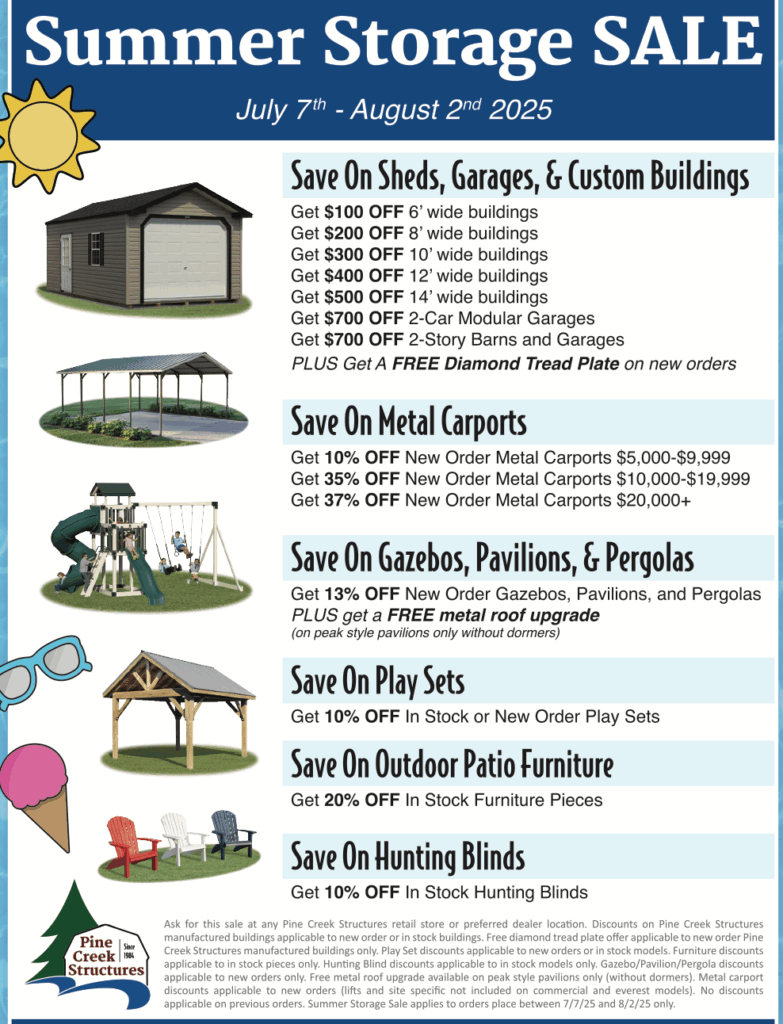
Summer Storage Sale 

24 x 28 Custom Two-Story Two-Car Garage with a Cape Cod style Roof

Summer is the perfect time to get organized—and there’s no better way to do it than with a quality structure from Pine Creek Structures in Maryland! Whether you need more room for your tools, toys, or outdoor gear, our Summer Storage Sale is here to help you save big on the buildings you need.

From sheds and garages to gazebos and hunting blinds, we’re offering exclusive discounts to help you upgrade your space and enjoy your property more than ever.

Save on Sheds, Garages, & Custom Buildings

Looking to finally clear out the clutter or create your dream workshop? This is your moment. Our handcrafted buildings are built to last—and now, they’re more affordable than ever.

Summer Sale Discounts:

  • $100 OFF 6’ wide buildings
  • $200 OFF 8’ wide buildings
  • $300 OFF 10’ wide buildings
  • $400 OFF 12’ wide buildings
  • $500 OFF 14’ wide buildings
  • $700 OFF 2-Car Modular Garages
  • $700 OFF 2-Story Barns and Garages

PLUS – Get a FREE Diamond Tread Plate on all new orders!

Save on Metal Carports

Protect your car, RV, or equipment from the elements with a durable metal carport. For a limited time, enjoy major discounts based on your purchase amount:

  • 10% OFF new orders of $5,000–$9,999
  • 35% OFF new orders of $10,000–$19,999
  • 37% OFF new orders of $20,000+

Save on Gazebos, Pavilions & Pergolas

Create the backyard oasis you’ve always wanted! Our beautiful, Amish-built outdoor structures make a perfect shady spot for relaxing or entertaining.

Get 13% OFF new orders of gazebos, pavilions, and pergolas
PLUS receive a FREE metal roof upgrade on peak style pavilions (without dormers)!

Save on Play Sets

Keep the kids active and outdoors this summer with a new play set they’ll love!

Enjoy 10% OFF both in-stock and new order play sets during the sale.

Save on Outdoor Patio Furniture

Add style and comfort to your porch, patio, or garden with premium outdoor furniture.

Take 20% OFF all in-stock outdoor furniture pieces.

Save on Hunting Blinds

Gear up for hunting season early and save while you do.

Get 10% OFF in-stock hunting blinds.

Don’t Miss Out!

These offers are only available until August 2nd, 2025. Discounts apply to new orders and in-stock items only—so hurry in and take advantage before the summer ends! View our entire inventory online or visit in person!

Need help customizing your structure? Our team is happy to help!

Vinyl Playsets vs. Wooden Playsets: Which Is The Better Investment?

Large vinyl playset with many kids climbing and swinging

When it comes to choosing the perfect playset for your backyard, you’re not just picking a piece of playground equipment—you’re investing in years of outdoor fun, imagination, and physical activity for your children. Choosing the right backyard playset is a big decision—it’s where your kids will climb, swing, slide, and let their imaginations soar.

At Pine Creek Structures, we know that safety, durability, and style matter. But often people get caught up in the question of whether they should purchase a wood or vinyl playset.

Let’s break down the pros and cons of each to help you make the best choice for your family. Each material has its unique advantages and we want to help you understand those differences so that you can choose the best material based on your needs.

Continue reading

What Is LP Smart Side? Explaining This Shed Siding Choice

LP Smart Side is one of the most popular siding types for outdoor storage buildings at Pine Creek Structures. But what is it? Let us explain…

Like T1-11 siding, LP Smart Side siding features a cedar wood texture. It can be painted in a variety of colors so your building can match the color of you home or other outbuildings.

Variety of colors on LP Smart Side Siding with cedar texture

While it has the outer appearance of the T1-11 siding you may know, the similarities stop there. T1-11 siding is typically made of Plywood or OSB. LP Smart Side is an engineered wood siding product, meaning its is designed for superior durability.

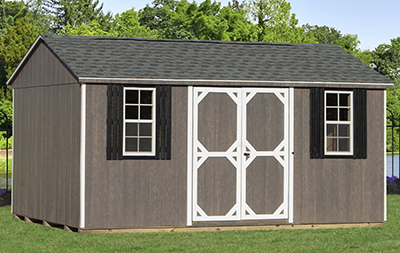
Peak Style Storage Shed with LP Smart Side Siding
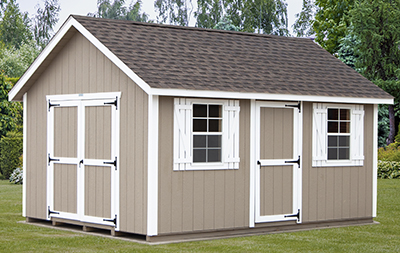
Cape Cod Style Storage Shed with LP Smart Side Siding

T1-11 siding is susceptible to water damage, which can cause warping, swelling, delamination, and rot in T1-11 siding. Regular maintenance is required to prevent these issues. It is also highly susceptible to damage from insects (like termites). LP Smart Side siding resists moisture because of the advanced binders and wax that are used to treat each wood strand individually. Every panel of LP Smart Side goes through their SmartGuard® zinc borate-based process to help resist fungal decay and termite damage. LP Building Products tests their sidings in the harsh jungle environment in Hilo, Hawaii with over 170″ of rain annually, high humidity, and a large termite population. LP Smart Side is proven to be a durable siding choice.

 LP Smart Side siding not only makes the exterior of your new storage shed beautiful, but also the inside! It features LP Building Products’ Smart Finish. This durable overlay provides a clean look inside your building.

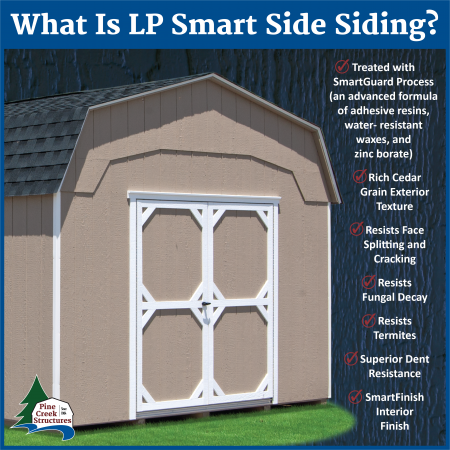
What Is LP Smart Side Graphic

LP Smart Side Features:

✔ Treated with SmartGuard Process*
✔ Free of Knots, Patches, and Face Voids
✔ Comprehensive 5/50-year Limited Warranty**
✔ Resists Fungal Decay
✔ Resists Termites
✔ Resists Face Splitting and Cracking
✔ Rich Cedar Grain Exterior Texture
✔ SmartFinish Interior Finish
✔ Superior Dent Resistance***

At Pine Creek Structures, we also offer a board ‘n’ batten style siding made for LP products. LP Board ‘N’ Batten siding provides the rustic and charming look of traditional pine boards, with the strength and durability of LP’s products. The only minor difference is LP Board ‘N’ Batten siding does not feature the SmartFinish interior. We recommend choosing a polyurethane color for buildings with LP Board ‘N’ Batten siding for an even more beautiful natural wood look.