
Quick answers
| Where | 8236C Veterans Highway, Millersville, MD 21108 (Anne Arundel County) |
| Phone | (410) 729-8747 |
| Hours | Mon–Fri 9–5 · Sat 10–2 · Sun closed |
| Lead time | Typically 2–3 weeks, year round — we own our plants |
| Free delivery | First 20 miles; per-mile fee beyond, based on building width |
| Sizes | 6×6 through 14×40 |
| Foundation required | Minimum 4 inches of 2B stone — this is a warranty condition, not a suggestion |
| Warranty | 6-year top-to-bottom on heavy-duty buildings (1 year on the Madison economy line) |
| Financing | 36-month rent-to-own, no credit check, with exclusions · GreenSky financing |
| Permits | Vary by county — check before you order |
On this page: How long it takes · What “Amish-built” means · Where to buy · Delivery range · Styles · Sizes · Permits & HOA · What affects price · Warranty & site prep · Delivery day · Financing · Questions to ask any dealer · Before you order · FAQs
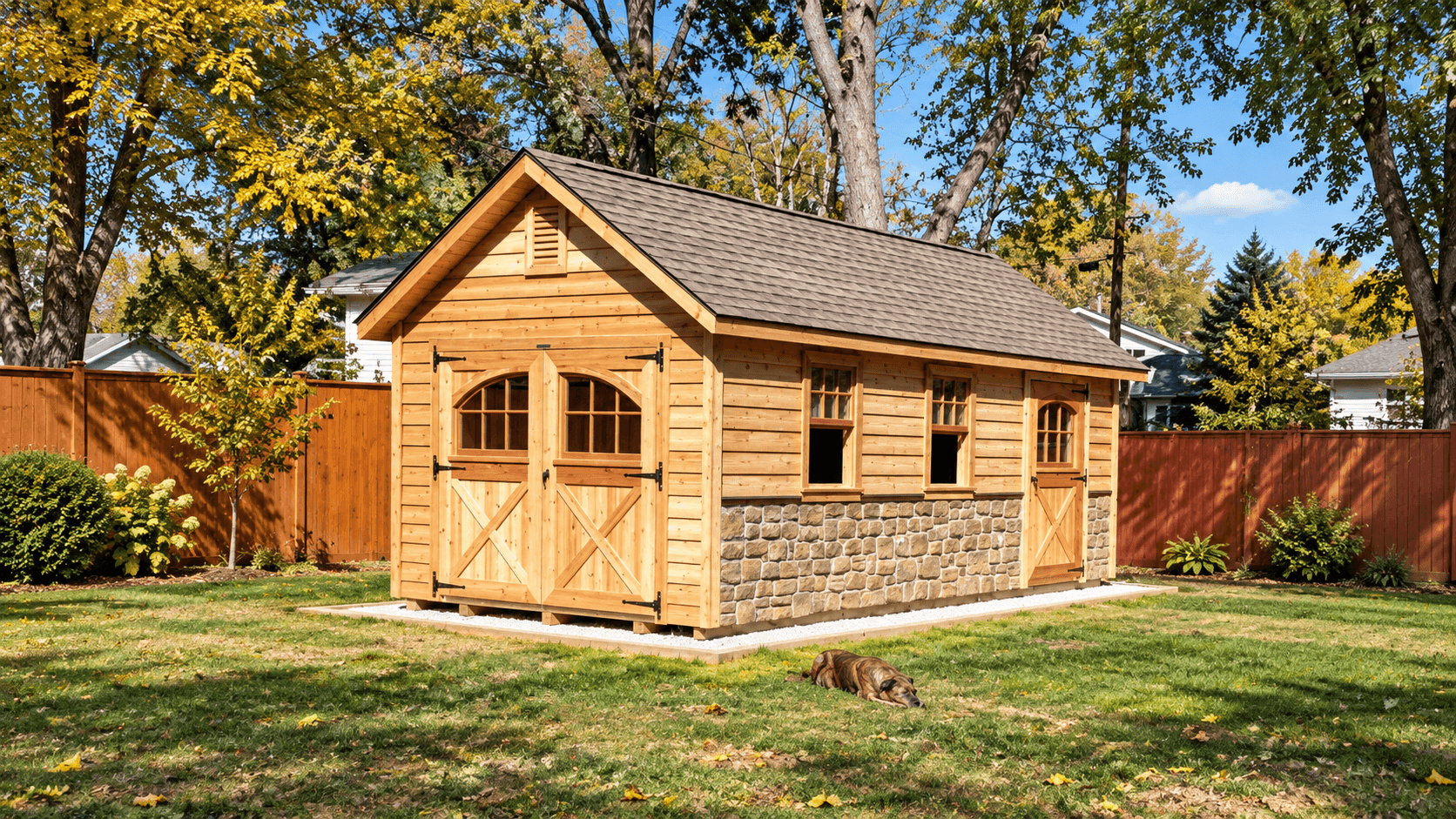
“Amish-built” is a phrase anyone can put on a sign. As far as we’re aware there’s no certifying body behind it and no standard a building has to meet to carry the label — which means it can describe a shed framed by hand in an Amish shop, or a building that came off an automated line and was given a barn-shaped roof.
That makes it a hard thing to shop for. Most of what’s written about Amish sheds argues about whether they’re worth the money. This page doesn’t. It answers the practical questions instead: who actually builds them, where you can buy one in Maryland, how far they’ll deliver, what styles and sizes you can order, what the warranty actually covers, and what you need to have ready before the truck shows up.
A note on names: MD Sheds is Pine Creek Structures’ Millersville, Maryland location. Pine Creek builds the buildings; MD Sheds is where you buy them in Maryland. When this page says “we,” it means both.
If you’re still weighing Amish-built against a big box kit, Amish-Built vs. Big Box Store Sheds covers that decision in detail. What follows assumes you’ve mostly made up your mind.
How long you’ll wait
Typically two to three weeks, year round.
That’s worth a sentence of explanation, because it’s the one number where the answers across Maryland differ wildly. Pine Creek owns its manufacturing plants. Most shed sellers don’t — they order from a manufacturer and wait in the same queue as everyone else, which is why lead times from a lot of dealers stretch to eight, ten or twelve weeks once the spring rush starts and stay there into the fall.
Owning the plants is what keeps our timeline flat through the year. If you’ve been quoted a date in December for a shed you wanted in October, it’s worth a phone call to compare.
Custom specifications, two-story buildings and modular garages take longer than a standard shed. The store will give you a real date when you order rather than a range.
What “Amish-built” actually means in Maryland
Here’s the part most shed sites leave out: many Amish sheds sold in Maryland aren’t built in Maryland.
A large share are built in Pennsylvania — Lancaster, Lebanon, Dauphin and the surrounding counties — and delivered south. That isn’t a knock on anybody. Amish woodworking communities are concentrated in that part of Pennsylvania, and that’s where the shops are. But it explains a few things that confuse Maryland buyers, like why delivery ranges get quoted in miles rather than counties.
What matters is the distinction between three things that all get called the same name:
Built by Amish craftsmen. The building is framed, sided and finished by hand in an Amish shop. The company can tell you where the shop is.
“Amish-style” or “Amish-inspired.” A design language — the gambrel roof, the barn doors, the cupola — applied to a building manufactured conventionally. Nothing wrong with those buildings, but the label describes the look, not the labor.
Resold. A dealer buys finished buildings from a manufacturer and puts their own name on the lot. Sometimes the original manufacturer is genuinely Amish.
The question that sorts these out is a boring one: who built this specific building, and can you tell me about the shop? A company that builds its own can usually answer in a sentence. A dealer that doesn’t know its manufacturer may have a harder time.
Pine Creek Structures has been family owned since 1984 — forty-plus years — and our buildings are manufactured by our own team of Amish craftsmen. The Millersville lot is where you can stand in them.
Where you can buy Amish sheds in Maryland
The showroom is in Millersville, off Veterans Highway in Anne Arundel County.
MD Sheds — Pine Creek Structures 8236C Veterans Highway, Millersville, MD 21108 (410) 729-8747 Monday–Friday 9:00am–5:00pm · Saturday 10:00am–2:00pm · Sunday closed
It’s worth going in person if you can. Photographs flatten sheds badly — a 10×16 looks enormous in a listing photo and modest in a backyard, and the difference between a 6-foot and a 7-foot sidewall (the height of the wall before the roof starts) doesn’t read at all until you’re standing under one. Most people who come to the lot change their mind about at least one thing.
How far we deliver
Delivery is free for the first 20 miles from the Millersville lot. After the initial 20 miles there’s a small fee per mile, depending on the size of your building. The store can give you an exact number once you know what you’re ordering, so it’s worth asking when you get your quote.
We deliver throughout Anne Arundel County and the surrounding area — Millersville, Severna Park, Crownsville, Gambrills, Davidsonville, Riva, Pasadena, Glen Burnie, Odenton, Annapolis and Crofton — and beyond that into Howard, Prince George’s and Baltimore counties, including Columbia, Ellicott City, Laurel and Bowie.
Tell us at the point of order whether you’re ready for the building right away or not, along with anything else that might affect the delivery.
When the shed can’t be driven in
Most sheds arrive finished. The truck backs in, the building comes off, and it’s set on your pad the same day.
When access is tight — a narrow side yard, a gate, a fence line, a turn between houses — we use a Shed Mule. It puts roughly 15,000 pounds less weight into your yard than a delivery truck would, and it minimizes yard damage even when the ground is wet. Allow extra room for the equipment to pass through any opening: no less than a foot of clearance beyond the width of the building.
When that still won’t work, or the building is too large to travel in one piece, our on-site crew can prep the materials at the production facility and assemble the building in place instead. That option comes at an added cost.
Either way, mention any access constraints on the first call rather than on delivery day.
The styles you can order
Shed styles aren’t only cosmetic — the roofline determines how much usable space is inside, particularly overhead.
Browse the full range on the sheds category page. The short version:
The core styles
Peak (A-Frame). The standard pitched roof. Simple, inexpensive, and it disappears into a backyard — often exactly what you want when an HOA is involved or the shed sits in view of the house.
Gambrel / Dutch Barn. The classic barn profile with the double-pitched roof. Look here if you want storage overhead: the gambrel shape produces far more vertical space than a peak roof at the same footprint, and most Dutch barns can take a loft. If you’re storing things you need twice a year, that loft is the whole argument.
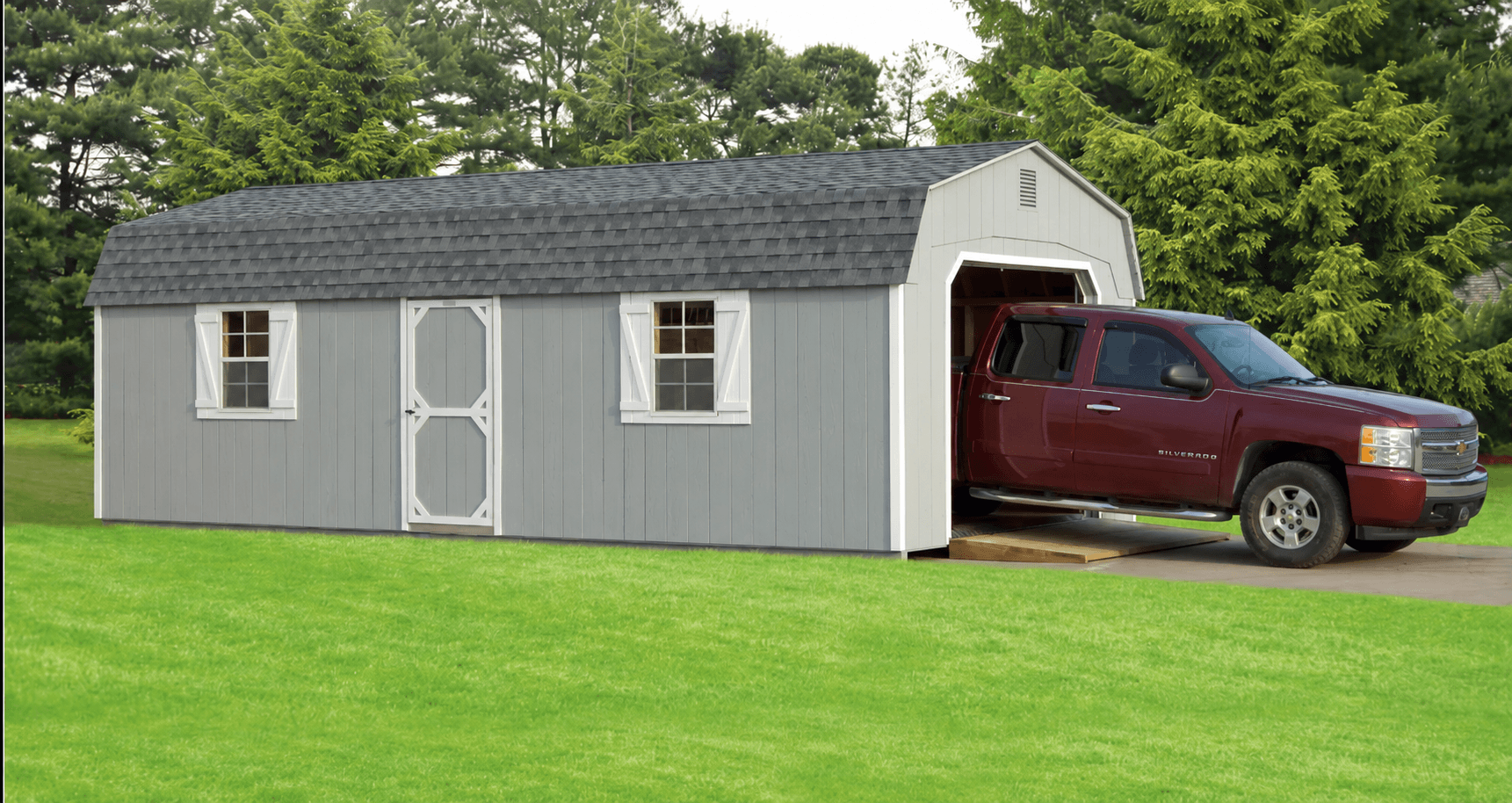
Cottage. A softer, more residential look than the peak. Reads as part of the house rather than as an outbuilding. Popular where the shed is visible from the patio.
The premium styles
Cape Cod. Steeper roof, dormers available, and a frontage that looks deliberately designed. The direction people go when the shed will be a workshop or studio rather than pure storage.
Victorian. Ornamental trim and detailing — the most decorative option in the range.
Hip. The roof slopes on all four sides. Lower profile, and often the right answer when a height restriction or a sightline is the constraint.
The distinctive ones
Providence Carriage House. The showpiece. Carriage-house proportions and detailing, with metal roofing standard at no additional charge.
Studio. A clean single-slope profile — the one that doesn’t look like a shed. Increasingly the pick for home offices.
Mini Barn. The small-footprint option for tools, mowers and bikes.
A note on roofing: metal roofing is standard at no extra cost on the Providence Carriage House, on two-story buildings, and on two-car modular garages. On other styles it’s an upgrade over architectural shingles.
We also build garages, metal buildings and carports, and playsets from the same lot. For detached garages, Amish-Built Garages in Maryland covers what’s different about those builds.
Want to see these in person? The Millersville lot is at 8236C Veterans Highway, Millersville, MD 21108. Call (410) 729-8747 — bring your yard dimensions and we’ll tell you what fits.
Sizes, and which ones fit Maryland yards
Standard sheds run from 6×6 up to 14×40.
In practice, most Maryland homeowners land between 8×12 and 12×20. Smaller and you’ve bought a tool locker; larger and the lot, the setbacks and the permit office all start having opinions.
Two things drive the decision more than people expect:
Sidewall height. A taller sidewall changes what you can put against the walls and whether you can stand comfortably at a bench. It usually costs less than adding footprint, and it’s the upgrade people most often wish they’d taken.
The permit threshold. More on that below.
See Best Shed Sizes for Maryland Backyards for sizing against a real yard.
Permits, setbacks and HOA rules
Three separate sets of rules apply, and clearing one doesn’t clear the others.
Building permits. Maryland has no single statewide threshold — it’s county by county, and the thresholds move. In several jurisdictions a shed under a certain square footage doesn’t need a building permit, while anything over it does.
Setbacks. These apply regardless of whether a permit is required. No permit needed does not mean put it anywhere. Distances from property lines, easements and rights-of-way are separate rules, and they’re the ones most commonly discovered after the fact.
HOA covenants. In much of Anne Arundel, Howard and Montgomery County this is the binding constraint, not the county code. HOAs commonly restrict size, placement, whether the building is visible from the street, roof and siding color, and sometimes style. Approval can take weeks. Check your covenants and submit for approval before you order, not after — county rules and HOA rules are enforced by different people and neither one cares what the other said.
County-level detail is written up separately rather than summarized badly here:
Do You Need a Permit to Build a Shed in Maryland? — the county-by-county overview
One more: running electricity to a shed generally requires its own permit in Maryland jurisdictions, separate from any building permit. If you’re planning a workshop, office or studio, ask your county what’s required before you finalize the build.
Changing a size on an order is easy. Moving a delivered building is not.
What affects the price of an Amish shed
Shed pricing varies too much to publish a meaningful figure here — the same footprint can differ substantially depending on how it’s specified. For a current number on a specific building, call the Millersville store.
What’s worth understanding is what moves the price, because most of it is under your control. Roughly in order of impact:
Siding. The largest variable. From least to most expensive: LP SmartSide (an engineered wood product), then vinyl and LP Board & Batten, then traditional board & batten and LP Shiplap, with cedar and log at the top.
Footprint. The obvious one — and usually not the biggest lever.
Roof style. Gambrel and cape cod rooflines cost more to build than a simple peak. Metal roofing over shingles is an upgrade except where it’s standard.
Floor system. The standard floor suits normal storage. If you’re rolling a mower or tractor in and out regularly, the heavier floor options are worth it.
Doors and windows. Where a build quietly gets expensive. Every extra window, a wider door, a transom — each is small, and they add up.
Delivery distance. Free inside 20 miles, per-mile beyond.
One thing worth flagging: LP SmartSide is frequently marketed as a premium engineered product, and it’s a good material with a strong warranty — but in our range it’s the entry point, not the top. If someone quotes it to you as an upgrade, ask what they’re comparing it to.
The most common mistake is buying footprint first and specifying everything else down to hit a number. Usually the better trade is a slightly smaller building specified properly.
What you get in writing
We don’t publish a fixed lifespan figure for our buildings. Site preparation, drainage, materials and maintenance all affect how long a building lasts, and any single number would be guesswork. The written warranty is a more useful thing to compare.
Pine Creek’s own coverage
6-Year Top-To-Bottom Warranty on heavy-duty buildings, covering defects in material and workmanship from the date of installation, repaired or replaced at our option
1 year on the Madison Series, our economy line
Not covered: bargain-corner and clearance buildings sold as-is, buildings with LP Cut Lap siding, and products manufactured by other companies
For context on the market, Pine Creek’s own comparison is that competitors typically offer “2-4 year warranties or no warranties at all.”
Manufacturer warranties on the materials
Material Coverage Vinyl siding, soffits and accessories Limited lifetime, 50-year transferable — defects, excessive fading, hail LP SmartSide 5/50-year limited — buckling, cracking, peeling, separating, chipping, flaking, rupturing, plus termite and fungal decay structural damage Legacy Metals roofing 40-year paint guarantee PerformMAX flooring (2018 and later) 25-year limited against delamination Tamko Titan XT shingles 160 mph wind warranty, Class 3 impact rated (UL 2218) Haley paint 12-year limited — peeling, blistering, fading, chalking, eroding
The condition nobody mentions until it’s too late
⚠ Before your shed is delivered
Your pad must have at least 4 inches of 2B stone for the Pine Creek warranty to remain valid. 2B stone is a clean crushed stone, roughly ¾ to 1½ inches, that drains freely. The pad must be level, square, free of voids, and extended about a foot past the building on every side.
This is a condition of the warranty, not a recommendation.
Pine Creek does not prepare sites — that’s the customer’s responsibility. The store managers keep lists of contractors who do this work locally, and it’s a normal thing to ask for when you order.
The reason the requirement exists is drainage. A shed set directly on soil wicks moisture into the floor system from below, and a floor that stays damp will fail long before anything else on the building does. The stone pad is what keeps the rest of the warranty meaningful. It’s also the single most common thing people skip to save a few hundred dollars, and the most expensive one to fix afterward.
If you’re weighing foundation options, Best Shed Foundations for Maryland goes through them in more depth.
What delivery day looks like
Before the truck arrives:
Stone pad down, level, square, extending a foot past the building on each side
Access route clear — cars moved, gates unlocked, low branches cut back, bins out of the way
Access width measured and communicated in advance — allow at least a foot of clearance beyond the building’s width
You know exactly where the building is going, and you’re there to point at it
Clear means genuinely clear. The crew can work around a lot, but they can’t move your neighbor’s car.
On the day, most sheds are set in well under an hour. The crew positions the building on the pad, levels it, and checks that the doors swing and latch correctly — which is the thing to watch. A shed that isn’t level shows up first in a door that won’t close cleanly. Don’t sign off until you’ve opened and shut everything.
Larger buildings and two-car modular garages arrive in sections and are finished on site, which takes longer.
Financing
Two routes, and which applies depends mostly on the building.
Rent-to-own. 36 months, no credit check. Real exclusions worth knowing up front — rent-to-own is not available on buildings over $9,000, two-story buildings, modular buildings, buildings without a floor, or anything intended to be lived in. For a typical storage shed it usually applies. For a two-car garage it usually doesn’t.
GreenSky financing. A conventional credit-checked route, and the practical option for anything outside the rent-to-own limits.
Programs vary by store, so the above is for Millersville. Confirm before you plan around either.
Questions to ask any shed dealer
Including us. If a seller can’t answer these, that tells you something:
Who built this specific building, and where? Not “it’s Amish-built” — which shop.
What’s your workmanship warranty, in years, and what voids it? The second half matters more than the first.
What foundation does it require, and is that a warranty condition?
Do you prepare the site, or is that on me?
What’s the siding, and where does it sit in your price range? If everything is described as premium, nothing is.
What’s the delivery fee to my address, and what happens if the truck can’t get in?
What are the financing exclusions? Most programs have them; not everyone volunteers them.
Before you order: a short checklist
| Before you order | Why it matters |
|---|---|
| Check county permit threshold and setbacks | Setback rules apply even when no permit is required |
| Check HOA covenants, start approval early | Approval can take weeks and is enforced separately from county rules |
| Measure your access route at its narrowest point | Allow at least a foot of clearance beyond the building’s width |
| Stake out the footprint in your yard | A shed that looks big in a photo reads small in a real backyard |
| Decide style and sidewall height | Sidewall is the upgrade people most often wish they’d taken |
| Line up the stone pad, or a contractor to build it | 4 inches of 2B stone is a warranty condition, not a suggestion |
| Get a delivery quote for your address | Free inside 20 miles, per-mile fee beyond, based on building width |
Come see one
The fastest way to settle most of this is to stand in a few.
MD Sheds — Pine Creek Structures 8236C Veterans Highway, Millersville, MD 21108 (410) 729-8747 Monday–Friday 9:00am–5:00pm · Saturday 10:00am–2:00pm
Call with your yard dimensions and your county and we can tell you in one conversation what will fit, what it needs underneath it, and what delivery looks like to your address. Or send us a message and we’ll come back to you.
To browse current inventory and the full configurator, visit pinecreekstructures.com.
Frequently Asked Questions
Are Amish sheds worth it?
It depends what you're comparing them to. Against a big box kit assembled in your yard, the differences are in the framing, the fasteners, the floor system and the warranty. A hand-built shed with a 6-year workmanship warranty is a different product from a kit with a 1-year limited one. Against another custom builder, compare warranties and ask who actually built the building.
Are Pine Creek sheds actually built by Amish craftsmen?
Yes. Our buildings are manufactured by our own team of Amish craftsmen. We've been family owned since 1984.
Where's the closest place to buy an Amish shed near me in Maryland?
Our Maryland showroom is at 8236C Veterans Highway, Millersville, MD 21108, in Anne Arundel County, convenient to Annapolis, Severna Park, Glen Burnie, Odenton and Crofton. Call (410) 729-8747.
Do you deliver to Frederick, Gaithersburg or Glen Burnie?
Yes to all three. Glen Burnie is inside the free 20-mile radius. Gaithersburg and Frederick are beyond it, so a per-mile fee applies based on building width. Call for an exact quote.
How long does an Amish shed last?
We don't publish a lifespan figure. It depends on the site, the pad, the materials and maintenance. What we can point to is the warranty: 6 years top-to-bottom on heavy-duty buildings, with material warranties running from 12 years on paint to limited lifetime on vinyl siding.
Do I need a permit for a shed in Maryland?
It depends on your county and the size of the building. Several Maryland counties exempt small sheds from building permits, but setback rules apply either way, and HOA covenants are separate again. See our county-by-county permit guide at https://mdsheds.com/do-you-need-a-permit-to-build-a-shed-in-maryland-a-county-by-county-guide/.
What do I need to do to the site before delivery?
Put down a pad of at least 4 inches of 2B stone, level and square, extending about a foot beyond the building on each side. This is a warranty condition. Pine Creek doesn't do site prep, but the Millersville store keeps a list of local contractors who do.
Can I finance a shed?
Yes. 36-month rent-to-own with no credit check is available on most standard sheds, with exclusions for buildings over $9,000, two-story, modular, no-floor and residential-use buildings. GreenSky financing covers what rent-to-own doesn't.
What's the difference between "Amish-built" and "Amish-style"?
Amish-built means Amish craftsmen built the building. Amish-style describes the look on a building that may have been made any number of ways. The label isn't regulated, so the only reliable check is to ask who built it and where.